

About Pool Exercises
Swimming is one of the most enjoyable and effective ways to improve overall health and fitness. As a low-impact, full-body exercise, it engages nearly every major muscle group while providing an excellent cardiovascular workout that supports heart health, lung function, and endurance. Unlike many land-based activities, the buoyancy of water reduces stress on the joints, making swimming suitable for people of all ages and fitness levels, including older adults and those recovering from injuries. Regular swimming can also help strengthen muscles, improve flexibility, enhance balance and coordination, and increase overall stamina. In addition, it burns a significant number of calories, making it a valuable component of a healthy weight management plan.
Pool Exercises for Full Body Workout offer an excellent way to maximize these benefits by incorporating a variety of movements into your routine rather than simply swimming laps. Water walking, aqua jogging, resistance exercises with foam dumbbells, kickboard drills, and aquatic HIIT workouts add variety while targeting strength, mobility, balance, and flexibility. These exercises allow you to customize your workout based on your fitness level and goals, whether you’re aiming to lose weight, build muscle, rehabilitate an injury, or simply stay active. By combining swimming with structured Pool Exercises for Full Body Workout, you can create a well-rounded fitness program that keeps workouts engaging while delivering both physical and mental health benefits.
Because water supports a significant portion of your body weight, movements become easier on the knees, hips, and spine while still requiring the muscles to work against constant resistance. From water walking and aqua aerobics to strength-training drills and high-intensity interval workouts, pool exercises can improve balance, coordination, muscle strength, flexibility, and overall physical function. This combination of low impact and high effectiveness makes aquatic exercise an excellent choice for enhancing overall health, fitness, and long-term mobility.
Why is Water Exercise Good for You?
According to 2021 studies, swimming workouts are a convenient non-pharmacological approach for managing obesity, high blood pressure, high cholesterol, and type 2 diabetes. These activities can significantly improve blood flow, physiological functions, and metabolic processes.
Swimming is also used for improving cognitive function and reducing the risk of dementia. It is good for mental health, especially reducing the symptoms of depression, anxiety, or other disorders. But, in most cases, it is used for weight loss and muscle strength.
Water Reduces Body Weight
By immersing yourself in water, you can perform water exercises that can be hard to do on land. The inherent buoyancy of water boosts your flexibility and enhances your mobility.
Even people who are overweight or obese find it easy to swim. That’s because fat is less dense than bone and muscle, and water provides buoyancy, making it easier to exercise without feeling the full impact of your body weight.
To top it all off, completing laps in the pool results in a higher calorie burn compared to some other cardio exercises. If you spend half an hour a day doing pool exercises, accompanied by a balanced diet, you can shed about half a pound to 1.5 pounds per week.
Water Provides Constant Resistance
Water provides natural resistance, which improves muscle strength. Since it also supports most of your body weight, it lessens the impact on the joints. Therefore, people who recently had surgery or an injury can start water exercises sooner.
Pool Exercises for a Full-Body Workout
Each exercise has its role to play. Choose the one that feels comfortable for you and is something you can handle with your current swimming skills.
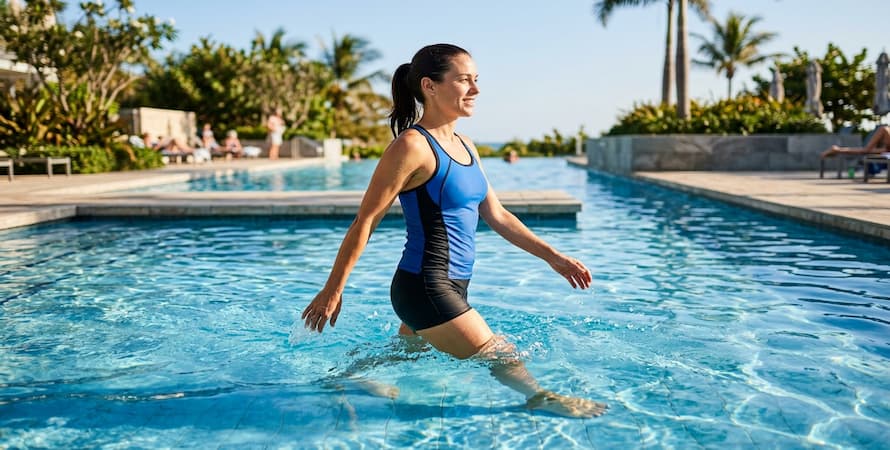
1. Walk in Water
Begin with water walking. In waist-deep water, walk across the pool while moving your arms like you would on land. Remember not to walk on your tiptoes and keep your back straight. Engage your belly muscles to prevent leaning too much forward or to the side.
To make these swimming workouts more intense, use hand webs or other tools to add resistance while moving your arms in the water. Wearing water shoes can help you maintain grip on the pool floor.
2. Water Arm Lifts
These pool exercises can make your arm muscles stronger. Using foam dumbbells will make it harder. Position yourself in water so that the level reaches up to your shoulder height while standing upright.
Keep the dumbbells at your sides, palms facing up. Bring your elbows close to your body and lift your forearms to water level. Rotate your wrists to turn your palms downward. Return your arms to the starting position.
Complete 1 to 3 sets of 10 to 15 repetitions for each workout.
3. Back Wall Glide
This workout engages your lower body muscles and core. First, grab the pool edge, bring your knees close to your chest, and push your feet against the wall.
Push yourself away from the wall and float on your back, trying to go as far as possible. Bring your knees toward your chest again. Then press your feet down to the pool floor, and ‘run’ back to the wall.
Repeat this aqua aerobics for 5 to 10 min.
4. Jumping Jacks
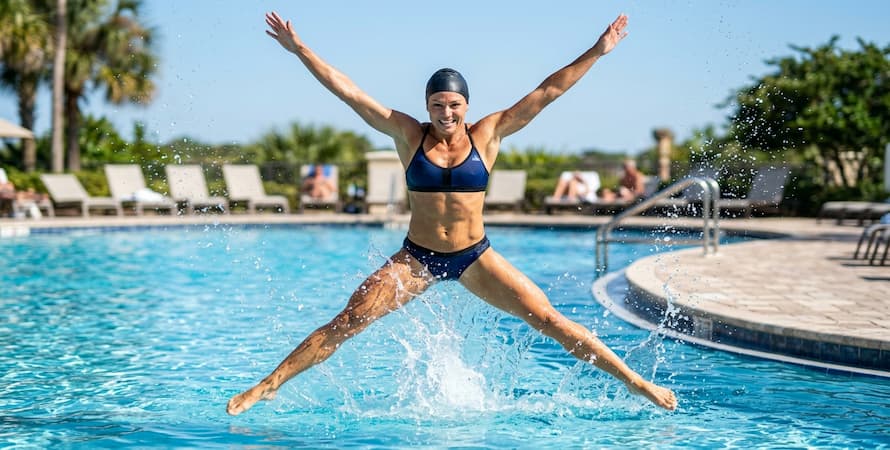
Water jumping jacks engage muscles in both your lower and upper body. You can increase the difficulty by using ankle or wrist weights.
Position yourself in water so that it reaches up to your chest. Begin with feet together and arms down. Jump, simultaneously spreading your legs apart and raising your arms above your head. Jump back to the starting position, feet together, arms down.
Complete 1 to 3 sets of 8 to 12 repetitions.
5. Leg Shoots
This is one of those swimming workouts that you can use to engage your legs, lower back, and core. To get the best results, avoid touching the pool floor with your feet throughout this exercise.
Bring your knees toward your chest. Quickly push your legs and feet forward, and try to float flat on your back. Bring your knees back in. Push your legs backward and float on your stomach.
Aim for 1 to 3 sets of 8 to 12 repetitions.
6. High-Knee Lift Extensions
This activity strengthens your core and lower body muscles. If you are looking for exercises that burn belly fat, then you might want to use resistance bands for swimming. They can have a profound impact on your fitness performance.
Position yourself in the water so that it reaches up to your waist. Tighten your core and lift your right leg. Bend your knee until your leg is parallel to the water surface. Hold your lifted leg for a couple of seconds. Straighten your leg and hold for a few seconds.
Gently lower your leg while keeping it straight. Do the same steps with your other leg. Keep going for 5 to 10 min.
7. Leg Kicks
This is another one of those exercises that burn belly fat. Especially if you pair them with a balanced diet. This workout targets your core and leg muscles. It can help shed some inches from your thighs, hips, and belly.
Place your hands on the pool’s edge or hold a kickboard. Use your legs to perform rapid and alternate kicking motions. Move your feet up and down in the water. Move your legs in a scissors motion and perform breaststroke kicks. Then, move on to dolphin kicks.
Complete each kick for 1 to 3 min.

8. Lateral Arm Lifts
This workout focuses on your upper body and works well with foam dumbbells. To start, stand in water at shoulder level. Grip the dumbbells at your sides. Lift your arms sideways until they’re parallel with the water and your shoulders. Bring your arms back to your sides.
Complete 1 to 3 sets of 8 to 14 repetitions.
HIIT Pool Workout — Burn More Calories in Less Time
High-Intensity Interval Training (HIIT) isn’t limited to the gym or track—it can be just as effective in the pool. A pool HIIT workout combines short bursts of intense effort with brief recovery periods, allowing you to elevate your heart rate while taking advantage of the natural resistance of water. Because water provides resistance in every direction, your muscles work harder during each movement without the high-impact stress associated with land-based exercise.
What Makes Pool HIIT So Effective?
Water is approximately 800 times denser than air, meaning every movement encounters continuous resistance. During high-intensity intervals, this resistance increases the workload on your muscles while simultaneously providing buoyancy that supports your body. As a result, a pool HIIT session challenges both your cardiovascular system and major muscle groups, helping you burn calories, improve endurance, and build strength—all in a relatively short amount of time.
Sample 20-Minute Pool HIIT Routine
A simple and effective beginner-to-intermediate workout uses 40 seconds of work followed by 20 seconds of rest. Complete the following exercises in sequence, then repeat the circuit four times for a total of approximately 20 minutes.
- Water Running: Run in chest-deep water, driving your knees high and pumping your arms vigorously.
- Water Jumping Jacks: Perform jumping jacks while pushing against the water to increase resistance.
- Tuck Jumps: Jump upward while pulling your knees toward your chest, then land softly in the water.
- High Knees: March or run in place while lifting your knees as high as possible.
- Lateral Shuffles: Move quickly side-to-side across the pool while maintaining an athletic stance.
Adjust the speed and intensity according to your fitness level, and take additional rest if needed.
Why Pool HIIT Is Better for Joint Health
Calorie Burn Data — High-Value Reader Information
| Exercise | Calories Burned (30 min) | Intensity Level |
|---|---|---|
| Water Walking | 120–180 cal | Low |
| Water Arm Lifts | 100–150 cal | Low–Medium |
| Jumping Jacks | 200–250 cal | Medium |
| High-Knee Lift Extensions | 200–280 cal | Medium–High |
| Leg Kicks | 180–240 cal | Medium |
| Back Wall Glide | 150–200 cal | Medium |
| Leg Shoots | 200–260 cal | Medium–High |
| Lateral Arm Lifts | 120–160 cal | Low–Medium |
Pool Exercises for Specific Needs
For Seniors
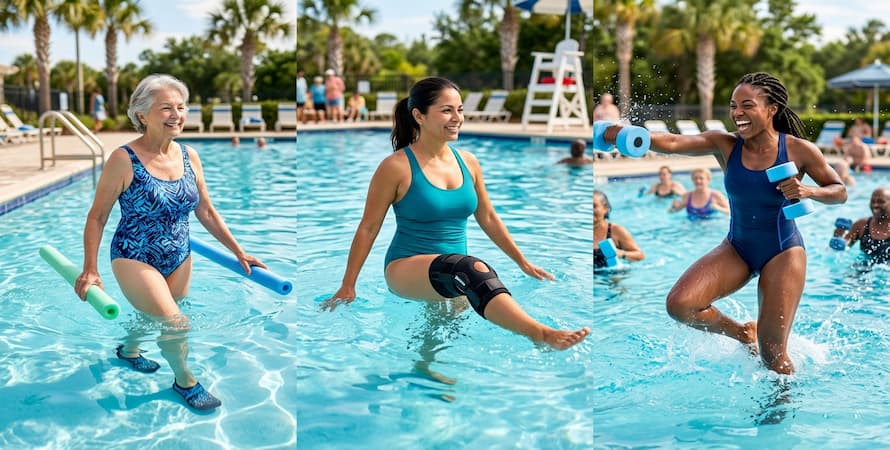
Pool exercise is one of the safest and most effective forms of physical activity for older adults. The natural buoyancy of water supports body weight, making movements feel easier while reducing stress on the joints. This allows seniors to stay active, improve fitness, and build confidence without the fear of falling that often accompanies land-based exercise.
Simple exercises such as water walking and arm lifts are excellent starting points. Walking forward, backward, and sideways through chest-deep water strengthens the legs while improving mobility. Gentle arm lifts and water pushes help maintain upper-body strength and shoulder flexibility without placing excessive strain on the joints.
The supportive nature of water also enhances balance, coordination, and stability. Because buoyancy reduces the risk of falls while still challenging the muscles responsible for posture and balance, aquatic exercise can help older adults maintain independence and improve overall quality of life.
For Bad Knees or Arthritis
People with knee pain or arthritis often struggle with traditional exercise because every step places substantial force on the joints. Exercising in chest-deep water can reduce the effective load on the joints by up to 90%, allowing individuals to move more comfortably while still gaining cardiovascular and muscular benefits.
Some of the best pool exercises for knee pain and arthritis include:
- Water walking to improve mobility and strengthen the lower body.
- Leg kicks with a kickboard to build hip and thigh strength while minimizing knee stress.
- Lateral arm lifts to strengthen the shoulders and upper body while improving balance and posture.
These exercises help improve joint mobility, muscle strength, and endurance with minimal impact. They can be particularly beneficial for people with osteoarthritis or those recovering from injury.
For Weight Loss
Pool workouts can be an effective component of a weight-loss program because they combine aerobic exercise with resistance training in a single session. Swimming, water jogging, aqua aerobics, and pool HIIT all elevate heart rate while the resistance of water increases energy expenditure and engages multiple muscle groups simultaneously.
For meaningful fat loss, combine regular pool-based cardio with a calorie-controlled, nutrient-rich diet. Most adults should aim for at least 3–4 pool exercise sessions per week, gradually increasing duration and intensity as fitness improves. Consistency is more important than workout intensity alone, and pairing aquatic exercise with healthy eating habits creates the calorie deficit needed for sustainable weight loss.
If you’re exploring additional evidence-based weight management strategies, you may also find our guide on weight loss pills helpful, which reviews common ingredients, safety considerations, and how supplements compare with lifestyle interventions.
Sample Pool Workout Plans
Mental Health Benefits of Pool Exercise
Safety Tips
- Stay out of the water when you are very tired or sick.
- Avoid eating a heavy meal before swimming.
- Stay off unstable or slick surfaces when climbing.
- Use a handrail to get into a pool.
- Swim in areas where you feel comfortable. Don’t delve too deep or farther than you can manage.
- Don’t jump or dive in shallow water.
- Never leave a phone charging by the pool.
- Don’t stand near the air conditioner after swimming as you may catch a cold. Instead, let the body rest at room temperature for a little while.
- Cleanse yourself properly from chlorine after swimming.

What Are the Benefits of Pool Exercises?
Whether you are at a beach, lake, or nearby swimming pool, aqua aerobics is a great way to get many benefits. You can expect swimming to:
Keep you cool. Most of the exercises you will be doing on land can cause you to overheat. Swimming is different. It decreases the risk of overheating and cools your body down relatively quickly.
Tone the muscles and keep the joints nimble. Swimming is a unique sport that provides a mix of both strength and cardiovascular training. Research shows that aqua aerobics boosts your physical strength and decreases the stress in the joints.
- Lose belly fat fast. According to a 2015 study, women who swam for 60 min 3 times weekly, managed to reduce their body fat. They also improved their muscle strength and flexibility and reduced their cholesterol through water exercises.
- Reduce the risk of injury. Aqua aerobics are an excellent choice for rehabilitation. They are almost pain-free and can help you heal faster.
- Keep the heart healthy. A 2014 report shows that regular 15- to 45-minute swimming can reduce systolic blood pressure and help manage hypertension. It can also relax the blood vessels and the internal organs.
Looking for an effective weight loss tool? Then the Phenocal weight loss supplement may be exactly what you need. The formula is designed to help you control the food cravings and boost energy so that you can make the most of your fitness journey. It can also make your metabolism work faster so that you can burn that fat sooner. It’s packed with 16 powerful ingredients, that can help you lose weight naturally.
Do You Need Any Special Equipment?
Takeaway
Doing water-based exercises that burn belly fat is an excellent opportunity to include in your physical activities. It could serve as a beneficial method for seniors, people who are overweight or obese or want to stay healthy to maintain an active lifestyle.
Water exercises alleviate joint discomfort, and promote joint mobility and flexibility. Once you are comfortable with the easy workouts, you can increase the intensity and experiment with different swimming equipment.
References
https://www.mayo.edu/research/clinical-trials/diseases-conditions/osteoarthritis
https://pmc.ncbi.nlm.nih.gov/articles/PMC5978883/
https://pmc.ncbi.nlm.nih.gov/articles/PMC2206347/
https://pmc.ncbi.nlm.nih.gov/articles/PMC9714032/