




Introduction
Carpal tunnel syndrome is a painful and restrictive condition that occurs when the median nerve becomes compressed at the bones in the wrist when the carpal tunnel is narrowed. The nerve transmits a feeling of numbness, tingling, and burning sensations in the thumb of the affected hand, index finger, middle finger, and part of the ring finger. It can be associated with repetitive hand movements and other conditions like diabetes and obesity.
This article provides an overview of what carpal tunnel syndrome is all about; it also includes details about its causes, symptoms, diagnosis, and treatment options available to you.
So if you’re experiencing any of these symptoms or have someone suffering from carpal tunnel syndrome, read on further to discover more about what it means to you.
What Actually Is Carpal Tunnel Syndrome?
Carpal tunnel syndrome is a common condition whereby the median nerve becomes compressed between bones in your affected wrist. It may cause tingling, numbness, and pain in your hand or fingers, which can make it hard to move them.
Carpal tunnel syndrome affects adults more than children because carpal tunnels are wider on adults’ wrists during puberty when growth hormone levels increase.
Common carpal tunnel syndrome symptoms include:
- Pain in your fingers, hand, or arm; numb hands
- Tingling that starts slowly with pins and needles progressing into the full-on weakness of one side (usually the thumb) when gripping particular objects like kitchen utensils for too long
- Difficulty moving muscles around the elbow area
Carpal tunnel syndrome can vary significantly from person to person and in severity at different times of the day, but what is for sure is that if you have CTS, at some point, you may experience some pain and reduced movement in the affected area.
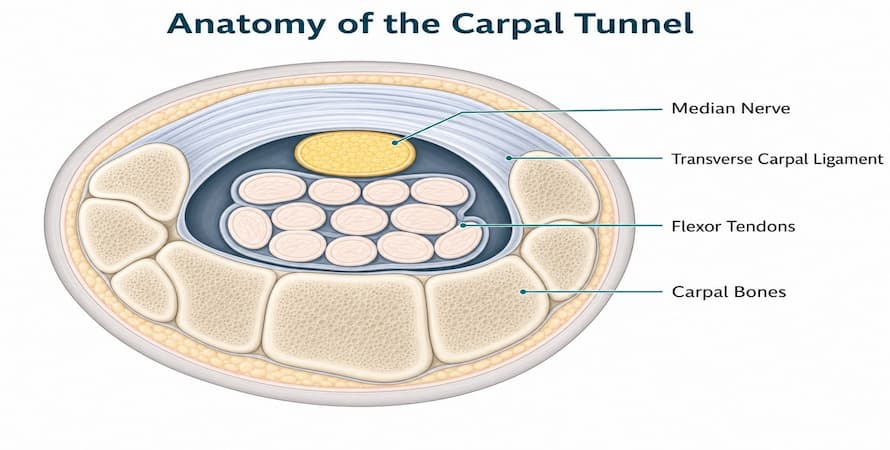
Anatomy of the Carpal Tunnel
Understanding what the carpal tunnel actually is makes the rest of the condition much easier to follow — why the symptoms appear where they do, why splints help, and what surgery actually changes.
A narrow passage with rigid walls
The carpal tunnel is a short, narrow channel on the palm side of the wrist, roughly an inch wide. Its floor and sides are formed by the carpal bones, the small cluster of wrist bones arranged in a shallow arch. Its roof is formed by the transverse carpal ligament, also called the flexor retinaculum, a tough band of fibrous tissue that stretches across the arch and closes it into a tunnel.
The important feature is that none of these walls give. Bone forms three sides and a strong ligament forms the fourth. When the contents of the tunnel swell, the tunnel cannot expand to accommodate them, so pressure inside rises.
What passes through it
Ten structures share this confined space:
- Nine flexor tendons that bend the fingers and thumb — four flexor digitorum superficialis tendons, four flexor digitorum profundus tendons, and the flexor pollicis longus tendon
- The median nerve, which lies closest to the roof of the tunnel, directly beneath the transverse carpal ligament
That position matters. The median nerve sits in the most vulnerable spot in the tunnel, pressed between the tendons below and the unyielding ligament above. When the tendons and their surrounding sheaths swell, the nerve is the structure that gets compressed.
What the median nerve does
The median nerve carries both sensation and movement signals to part of the hand.
Sensation. It supplies feeling to the palm-side surface of the thumb, index finger, middle finger, and the thumb-side half of the ring finger. This is why carpal tunnel symptoms follow that specific pattern and why the little finger is almost always spared — the little finger is served by the ulnar nerve, which runs outside the carpal tunnel entirely.
Movement. It supplies several small muscles at the base of the thumb, known as the thenar muscles, which control the thumb’s ability to move across the palm and oppose the other fingers. This is why advanced carpal tunnel syndrome causes weakness of grip and pinch, and why the fleshy pad at the base of the thumb can visibly shrink in long-standing cases.
One useful diagnostic clue
A small branch of the median nerve, the palmar cutaneous branch, splits off before the nerve enters the carpal tunnel and passes over the top of the ligament rather than through the tunnel. Because it bypasses the compressed area, sensation in the central palm is usually normal in carpal tunnel syndrome even when the fingers are numb. Numbness that includes the palm itself points a doctor toward a problem higher up the arm or in the neck instead.
Why pressure rises
Pressure inside a healthy carpal tunnel is low at rest. It increases when the wrist is bent forward or backward, which is why symptoms so often appear at night when the wrist curls during sleep, and why splints hold the wrist straight. It also increases when the tissue lining the flexor tendons, called the synovium, thickens and swells. In most long-standing cases, this thickened synovial tissue rather than the tendons themselves is the main source of the crowding.
Causes and Risk Factors
Carpal tunnel syndrome has one immediate mechanism — raised pressure on the median nerve inside the tunnel — but many different factors can produce it. In a large share of cases, no single cause can be identified, and the condition is described as idiopathic.
Anatomy you are born with
Tunnel size varies naturally between people, and a smaller tunnel leaves less margin before pressure rises. This partly explains why carpal tunnel syndrome runs in families and why women are affected roughly three times as often as men, since women on average have smaller carpal tunnels. A family history of the condition is a genuine risk factor.
Medical conditions
Several health conditions raise risk substantially, in some cases more than occupational factors do:
- Diabetes — high blood sugar over time can damage nerves and make the median nerve more vulnerable to pressure
- Rheumatoid arthritis — inflammation of the joint and tendon linings crowds the tunnel
- Hypothyroidism — an underactive thyroid can cause tissue changes that increase tunnel contents
- Obesity — associated with increased risk, though the mechanism is not fully settled
- Kidney disease requiring dialysis — protein deposits can accumulate in the tunnel
- Gout — crystal deposits can affect the tendon sheaths
- Amyloidosis — abnormal protein deposits in the tunnel
Pregnancy and hormonal factors
Carpal tunnel symptoms are common in pregnancy, particularly in the third trimester, driven by fluid retention that raises pressure in the tunnel. The encouraging news is that pregnancy-related carpal tunnel syndrome often resolves on its own within weeks to months after delivery, so conservative management is usually the first approach. Symptoms also occur more frequently around menopause.
Injury and structural causes
A wrist fracture, particularly a distal radius fracture, can narrow the tunnel either immediately through swelling or later through changes in bone alignment as it heals. Dislocations, ganglion cysts, and, rarely, tumors inside the tunnel can have the same effect.
Hand use and occupation
This is the most widely assumed cause and also the most frequently misunderstood. Certain patterns of hand use are associated with increased risk, particularly:
- Forceful gripping, especially when sustained or repeated
- Prolonged use of vibrating tools, which has among the strongest occupational evidence
- Sustained extreme wrist positions, held well beyond neutral
- Highly repetitive hand work performed for long periods without variation
Assembly line work, meat and food processing, construction, and trades involving power tools show higher rates than the general population.
What the evidence does not strongly support is the popular belief that ordinary computer and keyboard use causes carpal tunnel syndrome. Multiple studies have found little association between routine typing and the condition. Keyboard work can certainly aggravate existing symptoms and cause other forms of wrist and hand discomfort, and good ergonomics remain worthwhile, but typing is not the major cause it is often assumed to be.
Other associations
Smoking and high alcohol intake have both been linked to increased risk, as has having another compression neuropathy elsewhere in the body.

Symptoms and How They Progress
Carpal tunnel syndrome usually develops gradually, and recognizing which stage you are at is useful, because the earlier stages respond far better to non-surgical treatment.
Early stage: intermittent, mostly at night
The first symptoms are typically numbness and tingling in the thumb, index finger, middle finger, and the thumb-side half of the ring finger, coming and going rather than being constant.
The strong nighttime pattern is the most characteristic early feature. People wake in the small hours with a numb, tingling, or burning hand, and instinctively shake it out or hang it over the side of the bed for relief. This happens because the wrist naturally curls during sleep, raising tunnel pressure, and because fluid redistributes when lying flat. Nighttime waking with hand numbness is one of the most telling signs of carpal tunnel syndrome.
Symptoms at this stage also appear during activities that hold the wrist bent — driving, holding a phone, reading a tablet — and ease when the hand is shaken or the position changed.
Moderate stage: symptoms during the day
As compression continues, symptoms extend into waking hours and become more persistent. People notice:
- Numbness and tingling during everyday tasks, not just at night
- Aching or burning that can radiate up the forearm, occasionally as far as the shoulder
- Reduced ability to distinguish textures or temperature by touch
- Increasing clumsiness — dropping objects, difficulty with buttons, zips, or picking up coins
- Symptoms lasting longer after the aggravating activity has stopped
Discomfort spreading up the forearm is common. Symptoms below the elbow that follow the median nerve pattern still point to the wrist as the source.
Advanced stage: constant symptoms and muscle loss
In long-standing untreated cases:
- Numbness becomes constant rather than intermittent, and may no longer come and go at all
- Grip and pinch strength weaken noticeably
- The thenar eminence — the fleshy pad at the base of the thumb — can visibly flatten or waste away
- The thumb loses some of its ability to move across the palm
- Paradoxically, pain and tingling can decrease at this stage as nerve fibers are lost, which some people mistake for improvement
This last point matters. Numbness that becomes constant and painless is not a sign the problem has resolved. It is a sign of more advanced nerve damage, and it warrants prompt assessment. Muscle wasting and long-standing constant numbness may not fully reverse even after successful surgery, which is the main reason not to wait.
Symptoms that suggest something else
Carpal tunnel syndrome does not typically cause numbness in the little finger, numbness across the central palm, neck pain, symptoms in both the hand and the shoulder together, or weakness in muscles above the wrist. These patterns suggest a different problem — ulnar nerve compression at the elbow, a pinched nerve in the neck, or another condition — and should be evaluated rather than assumed to be carpal tunnel syndrome.
How Carpal Tunnel Syndrome Is Diagnosed
Diagnosis begins with the history and physical examination. Nerve testing is used to confirm the diagnosis and grade its severity, particularly when surgery is being considered.
History
The pattern of symptoms often points to the diagnosis before any test is performed. A doctor will ask which fingers are affected, whether symptoms wake you at night, what activities bring them on, how long they have been present, whether you have noticed weakness or dropped objects, and about conditions such as diabetes, thyroid disease, or arthritis.
Physical examination and provocative tests
The examination checks sensation in the median nerve distribution, thumb strength, and the appearance of the thenar muscles compared with the other hand. Three provocative tests are commonly used.
Tinel’s sign. The examiner taps lightly over the median nerve at the front of the wrist. The test is positive if tapping produces tingling or an electric-shock sensation shooting into the thumb, index, middle, or ring finger. Tinel’s sign is quick and useful but not definitive — it can be negative in genuine carpal tunnel syndrome and positive in people without it.
Phalen’s test. The person holds both wrists fully bent forward, often by pressing the backs of the hands together, and maintains the position for up to 60 seconds. The test is positive if numbness or tingling develops in the median nerve distribution. Flexing the wrist raises pressure inside the tunnel, reproducing what happens overnight. Time to onset is informative — symptoms appearing within 30 seconds generally suggest more significant compression.
Durkan’s carpal compression test. The examiner presses firmly with the thumbs directly over the carpal tunnel for about 30 seconds. A positive result is the reproduction of numbness or tingling. In several comparison studies, this test has performed at least as well as Tinel’s and Phalen’s, and some clinicians consider it the most reliable of the three.
None of these tests is conclusive alone. They are used together, alongside the history, to build the clinical picture.
Nerve conduction studies and electromyography
Nerve conduction studies are the most established objective test. Small electrodes placed on the skin deliver a mild electrical stimulus to the median nerve and measure how fast and how strongly the signal travels across the wrist. In carpal tunnel syndrome, conduction slows at the point of compression. Electromyography, which uses a fine needle to assess electrical activity in the thenar muscles, may be added to check for muscle involvement.
These studies serve three purposes: confirming the diagnosis, grading severity as mild, moderate, or severe, and helping to exclude other nerve problems such as a pinched nerve in the neck or a more generalized neuropathy. Many surgeons want nerve conduction results before operating.
They have limits. Results can be normal in early carpal tunnel syndrome even when symptoms are typical, so a normal study does not rule out the condition when the clinical picture is clear. The test is also uncomfortable for some people, though it is brief.
Ultrasound
Ultrasound imaging of the median nerve at the wrist is increasingly used. A swollen nerve shows an enlarged cross-sectional area just before it enters the tunnel. Ultrasound is quick, painless, and free of radiation, and it can also identify structural causes such as a ganglion cyst. It is often used alongside rather than instead of nerve conduction studies.
Blood tests and other imaging
Blood tests do not diagnose carpal tunnel syndrome but may be ordered to identify contributing conditions — blood glucose or HbA1c for diabetes, thyroid function tests, and inflammatory markers if rheumatoid arthritis is suspected. X-rays may be taken if a previous fracture or arthritis of the wrist is a consideration. MRI is reserved for unusual cases.
Non-Surgical Treatment
Most people with mild to moderate carpal tunnel syndrome start with non-surgical treatment, and many improve without ever needing surgery. Results are best when treatment begins early, before numbness becomes constant.

Wrist splinting
Night splinting is the first-line treatment for mild to moderate cases and has good supporting evidence.
A carpal tunnel splint holds the wrist in a neutral, straight position. This matters because tunnel pressure is lowest when the wrist is straight and rises sharply when it bends in either direction. Holding the wrist neutral overnight prevents the curling that drives nighttime symptoms.
Practical points worth knowing:
- Neutral is the goal. Splints that hold the wrist bent backward are less effective. A properly fitted carpal tunnel splint keeps the wrist straight.
- Night use is the priority. Wearing a splint overnight is where most of the benefit comes from. Daytime use can help during aggravating activities but is harder to sustain.
- Give it time. Improvement typically takes several weeks. Many people abandon splints too early.
- Fit matters. An ill-fitting or over-tightened splint can be uncomfortable enough that people stop using it.
Activity and ergonomic modification
Identifying and adjusting the activities that provoke symptoms is a core part of treatment. Useful changes include taking regular short breaks from sustained hand tasks, varying tasks through the day, reducing grip force where possible, limiting vibrating tool use, and keeping the wrist closer to neutral during work. Where symptoms relate to a job, an occupational health assessment can help identify specific adjustments.
Corticosteroid injection
An injection of corticosteroid into the carpal tunnel reduces swelling of the tissue around the tendons, lowering pressure on the nerve. It has solid evidence for short-term symptom relief, and most people notice improvement within days to a few weeks.
The main limitation is duration. Relief frequently fades over months, and while some people get lasting benefit, many find symptoms return. For that reason, injections are often used to confirm that the median nerve is the source of symptoms, to provide relief while other measures take effect, or to manage a temporary situation such as pregnancy. Repeated injections into the same site are generally limited, as frequent corticosteroid exposure can affect nearby tendons.
A short course of oral corticosteroids is an alternative with some supporting evidence, though injection is generally more effective.
Physical and occupational therapy
A hand therapist or physical therapist can contribute several things:
- Nerve and tendon gliding exercises, which encourage the median nerve and flexor tendons to move smoothly within the tunnel rather than sticking to surrounding tissue
- Manual therapy to the wrist and forearm soft tissues
- Splint fitting and adjustment, which makes a real difference to whether a splint is worn consistently
- Ergonomic and activity assessment specific to your work and daily tasks
- Postural and forearm work, since tightness further up the arm can contribute to symptoms
Evidence for gliding exercises alone is modest, but as part of a combined program, therapy is a reasonable component of conservative care.
Treating underlying conditions
Where an associated condition is present, managing it is part of treating the carpal tunnel symptoms. Better blood glucose control in diabetes, treatment of hypothyroidism, and control of inflammatory arthritis can all reduce the pressure driving symptoms.
Oral medications
Non-steroidal anti-inflammatory drugs such as ibuprofen are widely used, but the evidence that they help carpal tunnel syndrome specifically is limited, since the underlying problem is mechanical compression rather than inflammation of the nerve itself. They may ease associated aching and can help a coexisting condition such as arthritis. Diuretics and vitamin B6 have been studied and are not supported by current evidence.
Joint and connective tissue support
Carpal tunnel syndrome is a nerve compression problem rather than a joint condition, and supplements do not relieve pressure on the median nerve. It is worth being clear about that distinction before considering any supplement.
There is a relevant overlap, though. Carpal tunnel syndrome occurs frequently in people who also have arthritis affecting the hands and wrists, and where both are present, the joint condition is managed on its own terms. Comfortable, mobile wrists and hands also make it easier to keep up the activity modification, gliding exercises, and daily tasks that conservative treatment depends on.
Combination formulas such as Flexoplex Joint Support are designed with joint health in mind rather than nerve compression, bringing together ingredients commonly used to support joint comfort, flexibility, and everyday mobility. For someone managing hand or wrist arthritis alongside carpal tunnel symptoms, that may be a useful part of a wider routine — but it sits alongside splinting, therapy, and medical treatment rather than substituting for any of them.
Supplements can interact with prescription medication. Anyone considering them should speak with their doctor or pharmacist first, particularly if they take blood thinners or have diabetes or kidney disease.
When to move on from conservative treatment
Non-surgical measures are generally given a trial of six to twelve weeks. Surgery is usually considered when symptoms fail to improve in that time, when numbness becomes constant, when nerve testing shows moderate to severe compression, or when there is any thumb weakness or muscle wasting. That last group should not wait, since delaying treatment risks permanent nerve damage.
Surgical Treatment: Carpal Tunnel Release
Carpal tunnel release is one of the most commonly performed hand operations, and outcomes are generally very good. The principle is simple: the transverse carpal ligament forming the roof of the tunnel is divided, which enlarges the space and relieves pressure on the median nerve. The ligament ends do not rejoin tightly, leaving permanently more room.
Open carpal tunnel release
The surgeon makes an incision in the palm, typically one to two inches long, and divides the ligament under direct vision. This is the traditional approach. It gives the clearest view of the nerve and surrounding structures, which is an advantage in complex cases, revision surgery, or where another problem such as a cyst needs addressing at the same time.
Endoscopic carpal tunnel release
The surgeon makes one or two much smaller incisions at the wrist and uses a camera to divide the ligament from inside the tunnel. Studies generally show a faster return to work and less tenderness at the incision site in the early weeks, with outcomes that even out between the two techniques by around three to six months. It is not suitable for every case.
Which is better
Both procedures relieve pressure effectively, and long-term results are broadly comparable. The choice depends on the specifics of your case, your surgeon’s experience, and what matters most to you in the recovery period. This is a decision to make with the surgeon rather than in advance.
What the procedure involves
Carpal tunnel release is usually performed as a day case under local anesthetic with the arm numbed, sometimes with light sedation. The operation itself typically takes 10 to 20 minutes, and most people go home the same day.
Recovery
Recovery varies, but a common pattern is:
- First few days — the hand is bandaged, kept elevated, and simple pain relief is usually sufficient. Fingers are moved gently from the start.
- One to two weeks — the dressing is reduced and stitches are removed if non-dissolvable.
- Two to six weeks — gradual return to light activity. Scar tenderness and some weakness of grip are normal and expected.
- Six weeks to three months — most people return to normal activity, including heavier work, though timelines vary with occupation.
- Up to a year — a degree of scar sensitivity or “pillar pain,” discomfort in the base of the palm either side of the scar, can persist and usually settles.
Hand therapy after surgery is sometimes recommended, particularly where there was significant weakness beforehand.
Outcomes and expectations
Success rates are high, and most people get substantial or complete relief of symptoms. Nighttime numbness is often the first thing to improve, sometimes within days. Where numbness had been constant for a long time, or where thumb muscle wasting had developed, recovery is slower and may be incomplete — the nerve can regenerate, but not always fully. This is the central argument for not delaying assessment once symptoms become constant.
Risks
Carpal tunnel release is a safe operation, but like any surgery it carries risks, including infection, bleeding, scar tenderness, pillar pain, temporary or rarely permanent weakness, injury to the median nerve or a branch of it, incomplete release requiring further surgery, recurrence of symptoms, and complex regional pain syndrome, which is uncommon but significant. Your surgeon will discuss these in relation to your own circumstances.

How Can I Prevent Carpal Tunnel Syndrome From Occurring?
There are some preventative measures you can take to avoid carpal tunnel syndrome or a flare-up of an existing condition, such as:
- Keep your hands warm
- Improve your posture
- Take regular hand breaks
- Keep inflammation low
- Make regular hand exercises part of your day
- Reduce the vigorous element of your tasks
When to See a Doctor
Make an appointment if you have numbness or tingling in the thumb, index, middle, or ring finger that keeps returning, if hand symptoms wake you at night, or if symptoms persist for more than a few weeks.
Seek assessment promptly, without waiting to see whether things settle, if:
- Numbness has become constant rather than coming and going
- You have noticed weakness in your grip or pinch, or you are dropping things
- The muscle pad at the base of your thumb looks flattened compared with the other hand
- Symptoms are worsening quickly
These suggest more advanced nerve compression, where delay risks changes that may not fully reverse.
Seek urgent medical attention for sudden severe hand pain, numbness following a wrist injury, or a hand that becomes pale, cold, or discolored.
Frequently Asked Questions
Q: Does carpal tunnel syndrome go away on its own?
Sometimes. Mild cases, and particularly carpal tunnel syndrome that develops during pregnancy, can resolve without treatment. More often, symptoms that have been present for months will persist or gradually worsen without intervention. Early treatment gives the best chance of avoiding surgery.
Q: Is typing the main cause of carpal tunnel syndrome?
No, despite how widely this is believed. Research has found little association between routine computer and keyboard use and carpal tunnel syndrome. Forceful gripping, vibrating tools, and sustained awkward wrist positions carry stronger occupational evidence, and medical factors such as diabetes, thyroid disease, and inherited tunnel size play a larger role than most people expect. Keyboard use can still aggravate existing symptoms, so good ergonomics remain worthwhile.
Q: Which fingers does carpal tunnel syndrome affect?
The thumb, index finger, middle finger, and the thumb-side half of the ring finger. The little finger is almost always spared, because it is supplied by the ulnar nerve rather than the median nerve. Numbness that includes the little finger suggests a different problem.
Q: Can I get carpal tunnel syndrome in both hands?
Yes, and it is common. Many people have it bilaterally, though usually one hand is worse. The dominant hand is often affected first or more severely.
Q: Does a wrist splint need to be worn all day?
Usually not. Night use delivers most of the benefit, because that is when the wrist naturally bends and symptoms peak. Daytime wear can help during specific aggravating activities, but full-time use is rarely necessary and is harder to maintain.
Q: How long does it take to recover from carpal tunnel surgery?
Most people manage light activity within two weeks and return to normal activity between six weeks and three months, depending on the work involved. Nighttime numbness often improves within days. Some scar tenderness can persist for several months and usually settles.
Q: Will carpal tunnel syndrome come back after surgery?
Recurrence is uncommon but possible. Where symptoms return, it may be due to incomplete release, scar tissue, or an underlying condition that has not been managed. Persistent symptoms after surgery should be reassessed rather than accepted.
Q: Can exercises cure carpal tunnel syndrome?
Nerve and tendon gliding exercises can help symptoms, particularly as part of a broader treatment plan, but they do not reliably resolve the condition on their own. They are best used alongside splinting, activity modification, and medical assessment rather than instead of them.
Q: Is carpal tunnel syndrome the same as arthritis?
No. Carpal tunnel syndrome is compression of a nerve; arthritis is a disease of the joints. They produce different symptoms — nerve compression causes numbness and tingling, while arthritis causes joint pain and stiffness. The two do occur together, and hand and wrist arthritis is a risk factor for carpal tunnel syndrome, which is why a careful examination matters when both are suspected.
Q: Can carpal tunnel syndrome cause permanent damage?
Yes, if left untreated for long enough. Prolonged severe compression can cause nerve fiber loss and wasting of the thumb muscles, and these changes may not fully reverse even after successful surgery. This is why constant numbness or any thumb weakness should be assessed promptly.
Conclusion
Carpal tunnel syndrome is an ailment where the median nerve becomes compressed between bones in your wrist. The compression causes tingling, numbness, and pain in your hand or fingers, making it hard to move them.
It affects adults more than children because carpal tunnels are wider on adults’ wrists during puberty when growth hormone levels increase.
Common carpal tunnel syndrome symptoms include aching hands with pins and needles progressing into weakness (usually the thumb) while gripping particular objects like utensils for too long.
You may have difficulty moving muscles around the elbow area, and this can vary significantly from person to person but what’s certain is that if you have CTS at some point, you will experience some pain and reduced movement in the affected area!
There are many routes of treatment available for those who have this debilitating condition; however, the more conservative routes of care are always the best ones to explore before moving on to some of the more invasive and surgical options of carpal tunnel relief.
References
- https://pmc.ncbi.nlm.nih.gov/articles/PMC6619426/
- https://pmc.ncbi.nlm.nih.gov/articles/PMC9389835/
- https://pmc.ncbi.nlm.nih.gov/articles/PMC10613832/
- https://pmc.ncbi.nlm.nih.gov/articles/PMC10058045/


