
Introduction
Arthritis is a general term often used for joint inflammation. However, arthritis can come in different forms. It can be Osteoarthritis or Rheumatoid Arthritis.
Though both cases affect the joints of the human body, the difference between osteoarthritis and rheumatoid arthritis is known by health specialists. Joints in good condition help a person move, twist, or bend. Healthy joints can glide against each other without any creaking sound. However, with arthritis, simple movements, such as walking and going up and down the stairs become challenging because of pain.
Arthritis is a disease that commonly affects the foot, knee, hand, hip, and spine. It can affect other joints in your body as well. Moreover, it is prevalent among the elderly and is incurable.
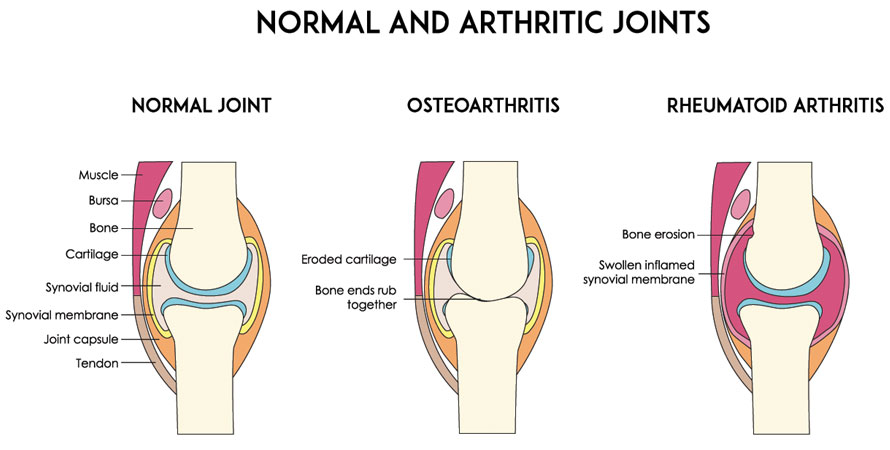
Osteoarthritis is caused by the wearing and tearing of your cartilage, which is responsible for cushioning your joints. It happens when cartilage breaks down, causing your bones to rub against each other, resulting in pain and more damage.
Rheumatoid arthritis, on the other hand, is a systemic or autoimmune disease. It happens when your body’s defense system attacks your joints for no reason. It can attack several joints of your body all at once.
Unfortunately, the primary cause for both OA and RA is unknown. That said, let us further dig into the question— rheumatoid arthritis vs osteoarthritis.
OA vs RA: Key Comparisons
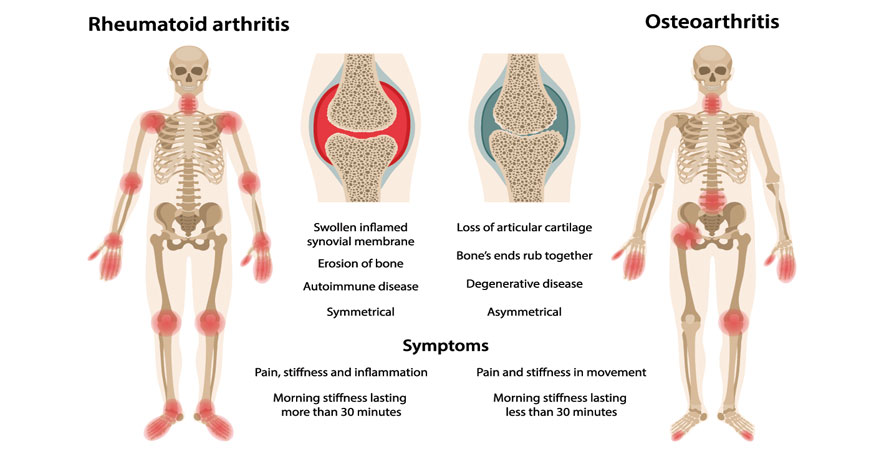
Over 30 million individuals in the U.S. have osteoarthritis. As mentioned, it is caused by the degeneration of the joints due to cartilage breakdown and movement may cause extreme pain in the joints. OA generally starts in one joint. It is common in elderlies above 65 years old.
On the contrary, rheumatoid arthritis is less common. About 1.5 million people get a diagnosis for rheumatoid arthritis. It is a chronic, autoimmune, inflammatory disease that targets your synovium/synovial membrane – the structure that contains the fluid that lubricates your joints.
However, it can have an impact on your organs as well. RA usually attacks multiple joints. It is common in individuals from 30 to 60 years old. Additionally, women tend to get the disease, while men acquire rheumatoid arthritis later in their lives.
Below is a table that gives you a glance at the key comparisons of Osteoarthritis vs. Rheumatoid Arthritis.
| Feature | Osteoarthritis | Rheumatoid Arthritis |
|---|---|---|
| Type of disease | Degenerative | Autoimmune, inflammatory |
| What drives it | Cartilage breakdown | Immune attack on the joint lining |
| Typical onset age | Usually after 50 | Usually 30 to 60 |
| Speed of onset | Gradual, over years | Weeks to months |
| Pattern | Asymmetric, often one joint first | Symmetric, both sides together |
| Joints first affected | Knees, hips, hands, spine | Small joints of hands, wrists, feet |
| Morning stiffness | Under 30 minutes | Over an hour |
| Effect of movement | Worsens with use, eases with rest | Improves with movement, worse after rest |
| Swelling | Hard, bony enlargement | Soft, warm, boggy |
| Whole-body symptoms | Rare | Common — fatigue, low fever, weight loss |
| Blood tests | Usually normal | Raised CRP and ESR; RF and anti-CCP may be positive |
| Affects organs | No | Yes — lungs, heart, eyes, blood vessels |
| Main treatment | Exercise, weight management, pain relief | DMARDs and biologics to control the disease |
| Urgency of treatment | Important but not time-critical | Time-critical — early treatment prevents permanent damage |
Symptoms of Rheumatoid Arthritis
Joint symptoms
- Symmetric involvement. The same joints on both sides are affected together. This is one of the most reliable features of RA.
- Small joints first. Typically the knuckles, the middle finger joints, the wrists, and the balls of the feet. The joints closest to the fingertips are usually spared, which is the reverse of osteoarthritis.
- Morning stiffness lasting more than an hour, often considerably longer, and returning after any period of inactivity.
- Soft, warm, boggy swelling rather than the hard bony enlargement of osteoarthritis. The joint may look puffy and feel spongy.
- Symptoms improve with movement. People often describe needing to “work through” the stiffness, and feeling better once they get going.
- Tenderness to light pressure, sometimes disproportionate to how the joint looks.
Whole-body symptoms
RA is a systemic disease, which means it affects more than the joints. These symptoms often appear before or alongside joint pain:
- Persistent fatigue that rest does not relieve
- Low-grade fever
- Loss of appetite and unintended weight loss
- A general sense of being unwell, sometimes described as feeling flu-like
- Dry eyes and dry mouth
Other features
- Rheumatoid nodules — firm lumps under the skin, usually near pressure points such as the elbows, forearms, knuckles, and heels. They occur in a minority of people and are highly specific to RA.
- Effects on other organs. RA can involve the lungs, heart, eyes, and blood vessels. It also raises cardiovascular risk, which is one reason treatment matters beyond joint comfort.
- Flares and remissions. Symptoms fluctuate, with periods of worsening followed by quieter phases.
Advanced changes
Where RA is untreated or poorly controlled, joint damage produces characteristic deformities: fingers drifting toward the little-finger side, bent and hyperextended finger positions, and loss of grip and dexterity. These changes are largely irreversible, which is the central argument for early treatment.
Symptoms of Osteoarthritis
Joint symptoms
- Pain that worsens with use and eases with rest. Stairs, squatting, kneeling, and getting up from a low chair are common triggers.
- Morning stiffness lasting under 30 minutes, typically clearing within a few minutes of moving.
- Gelling — stiffness after sitting still, which wears off quickly once you start moving again.
- Asymmetric pattern. One knee, one hip, or one thumb base is often affected well before the other, if the other is affected at all.
- Crepitus — a grating, crunching, or crackling sensation felt or heard on movement.
- Hard, bony enlargement of affected joints, particularly the fingers, where the swellings are permanent once formed.
- Reduced range of motion, developing gradually over years.
- A sense of the joint giving way, usually from muscle weakness rather than ligament damage.
Where it appears
Knees, hips, hands, spine, and the base of the thumb are the most common sites. In the hands, osteoarthritis affects the joints closest to the fingertips and the middle finger joints, producing the firm knobbly swellings known as Heberden’s and Bouchard’s nodes.
What osteoarthritis does not usually cause
This is as informative as the symptom list itself. Osteoarthritis does not typically produce fever, unintended weight loss, widespread fatigue, or the sense of being systemically unwell. It does not affect organs. If those features are present alongside joint pain, they point toward inflammatory arthritis and warrant assessment.
Advanced changes
In advanced osteoarthritis the joint space narrows substantially, bone spurs enlarge, alignment changes (producing bow-legged or knock-kneed appearance at the knee), and pain may become constant, including at rest and overnight. Muscle wasting around the joint is common.
Joint pain and inflammation can be a symptom of any disease. In rheumatoid arthritis, symptoms progress slowly for weeks. Stiffness and fatigue are the usual early symptoms. You can also expect low-grade fever and weight loss with a diagnosis for rheumatoid arthritis.
Symptoms of RA include:
- Stiff, tender, and swollen joints. It affects joints symmetrically (both sides), especially the neck, elbows, wrists, hands, knees, ankles, and feet. Take a note of these areas to identify the difference between osteoarthritis and rheumatoid arthritis.
- Morning stiffness. Morning stiffness is a common symptom of arthritis. It develops after sitting or sleeping for long hours. Usually, it will last for up to an hour or more.
- Nodules. RA nodules may vary in size. They can be as small as a pea and large as a mothball. A nodule is an obvious difference between osteoarthritis and rheumatoid arthritis. These bumps usually form on your leg bones, spine, knuckles, and elbows.
Additionally, a person with a diagnosis for rheumatoid arthritis may develop the following systemic symptoms:
- Appetite loss
- Weight loss
- Fatigue
- Low-grade fever
Contrastingly, OA symptoms can be mild or severe. Symptoms include the following:
- Sharp or burning pain. During the early stages of OA, pain may be constant. When pain is constant, it means the arthritis is starting to get worse.
- Joint stiffness. Starting your morning routine can be difficult when you have OA. Your joints will feel creaky and stiff until you move.
- Muscle weakness. With arthritis, the muscles surrounding your joints become weak due to lack of movement secondary to pain.
- Joint swelling. OA only causes a little swelling compared to RA. Swelling is usually seen in weight-bearing joints, such as the knees. Having inflamed joints is one difference between osteoarthritis and rheumatoid arthritis that you should notice immediately.
- Joint deformation. When OA worsens, joints start to deform.
- Limited joint motion. As arthritis aggravates, it will be difficult to extend or bend your joints.
- Sleeping problem. Stiffness and pain may disrupt a person’s sleep.
Additionally, OA of the spinal column can cause joint numbness due to the narrowing of your spinal canal. Narrowing of the canals can put pressure on your spinal nerves or spinal cord, which then causes the symptoms mentioned.
Diagnosis for OA and RA
How do people get a diagnosis for rheumatoid arthritis?
A doctor will advise you to take a physical exam, including your history. He may also suggest that you have an X-ray, blood tests, and other necessary tests to give you the correct diagnosis.
How do people get a diagnosis for osteoarthritis?
A doctor will examine what causes your joint pain. He will ask if you have the symptoms mentioned above. Your doctor will most likely suggest that you have an X-ray to see if you have joint damage. To rule out rheumatoid arthritis, your doctor may suggest that you undergo blood tests.
How Doctors Tell Them Apart
History and examination
In rheumatoid arthritis vs osteoarthritis, most of the distinction is made here, before any test. A doctor will ask how long morning stiffness lasts, whether the same joints are affected on both sides, whether movement improves or worsens symptoms, how quickly symptoms began, and about fatigue, fever, weight loss, and family history.
On examination, the character of the swelling is highly informative. Hard, bony enlargement points to osteoarthritis. Soft, warm, boggy swelling points to RA. The pattern of joints involved is equally telling: fingertip joints suggest osteoarthritis, knuckles and wrists suggest RA.
Blood tests
| Test | Osteoarthritis | Rheumatoid Arthritis |
|---|---|---|
| ESR and CRP | Usually normal | Usually raised |
| Rheumatoid factor (RF) | Negative | Positive in many, but not all |
| Anti-CCP antibodies | Negative | Positive in most; more specific than RF |
| Full blood count | Normal | May show anemia of chronic disease |
Two cautions worth stating plainly. A negative rheumatoid factor does not rule out RA, since a meaningful proportion of people with RA test negative. And a positive rheumatoid factor does not confirm it, as the antibody appears in some healthy people and in other conditions. Anti-CCP is the more specific of the two.
Imaging
X-ray shows different patterns in each condition. Osteoarthritis produces joint space narrowing, bone spurs, increased bone density beneath the cartilage, and cysts. RA produces erosions at the joint margins, loss of bone density around the joint, and more uniform joint space narrowing. X-rays are insensitive early in both conditions, so a normal X-ray does not exclude either.
Ultrasound and MRI detect inflammation of the joint lining and early erosions before they appear on X-ray, which is why they are increasingly used when inflammatory arthritis is suspected.
Referral
Where RA is suspected, prompt referral to a rheumatologist matters. Most health systems prioritize these referrals because starting disease-modifying treatment early substantially changes long-term outcomes. Osteoarthritis is usually managed in primary care, with orthopedic referral considered when surgery becomes relevant.
Treatment of Osteoarthritis
Treatment aims to reduce symptoms and preserve function. Cartilage loss cannot currently be reversed, but symptoms often improve substantially.
The foundations
Exercise has the strongest evidence of any osteoarthritis treatment. It reduces pain, improves function, and strengthens the muscles supporting the joint. The common fear that exercise accelerates joint damage is not supported by evidence. Useful approaches include low-impact aerobic activity, targeted strengthening (particularly the quadriceps for knee osteoarthritis), range-of-motion work, aquatic exercise, and tai chi.
Weight management matters most for the knee, hip, and spine, where load through the joint is a multiple of body weight with every step.
Physical and occupational therapy provide individualized programs, joint protection techniques, and practical adaptations.
Medication
- Topical NSAID gels for superficial joints such as the knee and hand, often tried before oral medication
- Oral NSAIDs at the lowest effective dose for the shortest period, with attention to stomach, kidney, and cardiovascular risk
- Acetaminophen, with more modest evidence than once assumed
- Corticosteroid injection for short-term relief during a flare
- Duloxetine for persistent osteoarthritis pain in some cases
Supportive measures and surgery
Walking sticks, braces, splints, supportive footwear, and heat or cold all have a place. Joint replacement is considered when symptoms are severe, function is significantly limited, and other measures have been exhausted, and generally has good outcomes for the hip and knee. Arthroscopic surgery is not recommended for osteoarthritis alone.
Treatment of Rheumatoid Arthritis
This is where the two conditions diverge most sharply. Osteoarthritis treatment manages symptoms. RA treatment aims to control the disease itself and prevent joint destruction.
Why timing matters
The first months after RA symptoms begin are sometimes described as a window of opportunity. Starting disease-modifying treatment during that period gives a significantly better chance of reaching remission and avoiding permanent joint damage. Damage that has already occurred cannot be undone. This is the single most important practical difference between the two conditions.
Disease-modifying treatment
Conventional DMARDs (disease-modifying antirheumatic drugs) act on the disease process rather than only on symptoms. Methotrexate is usually the first choice. Others include sulfasalazine, leflunomide, and hydroxychloroquine. They require regular blood monitoring.
Biologic DMARDs are targeted injectable treatments used when conventional DMARDs are insufficient.
JAK inhibitors are targeted oral treatments used in similar circumstances.
Supporting treatment
- Corticosteroids short-term, to control a flare while longer-acting treatment takes effect
- NSAIDs for symptom relief alongside disease-modifying treatment
- Exercise and physical therapy, which improve function and reduce fatigue
- Cardiovascular risk management, since RA raises cardiovascular risk independently
- Surgery where joint damage is established, including joint replacement and tendon repair
Treat-to-target
Modern RA care follows a treat-to-target approach: treatment is reviewed regularly and adjusted until low disease activity or remission is achieved, rather than settling for partial improvement. Many people with RA now reach remission, an outcome that was uncommon a generation ago.
Can You Have Both at Once?
Yes, and it is more common than people expect, particularly with age.
Having one condition does not protect against the other. Someone with long-standing RA may also develop osteoarthritis in their knees or hips, and someone with osteoarthritis can develop RA at any point.
There is also a specific relationship worth knowing: joints damaged by RA can go on to develop secondary osteoarthritis, because the original inflammation alters the joint surface and mechanics.
When both are present, symptoms can be confusing — a knee that hurts with activity and a hand that is stiff for two hours each morning may represent two different conditions in the same person. Each is treated on its own terms: disease-modifying medication for the RA, and exercise, weight management, and symptom control for the osteoarthritis.
If you have an established diagnosis of one and develop a new pattern of symptoms that does not fit it, that is worth raising rather than assuming it is the same condition spreading.
When to See a Doctor
Make an appointment if joint pain, stiffness, or swelling has persisted for more than a couple of weeks, or keeps returning.
Seek assessment promptly, without waiting, if any of the following apply. These suggest inflammatory arthritis, where early treatment changes the outcome:
- Morning stiffness lasting more than an hour
- Swelling in the small joints of the hands or feet
- The same joints affected on both sides of the body
- Joint symptoms alongside fatigue, fever, rash, or unintended weight loss
- Symptoms beginning before age 50
- Symptoms that improve with movement and worsen with rest
Seek same-day medical care if a single joint becomes severely painful, hot, red, and swollen, particularly with fever. This can indicate infection in the joint, which can cause damage within days.
Supplement Options for Both Conditions
Supplements are among the most searched-for options in both conditions, so it is worth being clear about what they can and cannot do, and about where the two conditions differ.
What no supplement does. No supplement repairs or regenerates cartilage. None modifies the underlying course of osteoarthritis, and none is a substitute for disease-modifying treatment in rheumatoid arthritis. Any product claiming to rebuild cartilage or to treat arthritis is overstating what is known.
The distinction that matters most. In osteoarthritis, supplements sit alongside exercise and weight management as part of a comfort-and-mobility routine, and the stakes of getting it wrong are relatively low. In rheumatoid arthritis, the stakes are different. RA causes permanent joint damage when the disease itself is not controlled, and that control comes from DMARDs and biologics prescribed and monitored by a rheumatologist. Anything that leads someone with RA to delay or replace that treatment causes harm that cannot be undone. Supplements may sit alongside RA treatment; they never sit in place of it.
Commonly discussed options
- Omega-3 fatty acids — the most studied in inflammatory joint conditions, and generally used alongside conventional treatment rather than instead of it
- Vitamin D — worth testing for, since low levels are common and correction supports normal muscle and bone function
- Glucosamine and chondroitin — widely used for joint comfort in osteoarthritis, though the evidence is mixed and guidelines differ on whether to recommend them
- Turmeric and curcumin — commonly used, with limited but growing research interest
Joint and connective tissue support
For people managing osteoarthritis, combination formulas such as Flexoplex Joint Support bring together ingredients commonly used to support joint comfort, flexibility, and everyday mobility, which may make it easier to keep up the exercise and daily activity that osteoarthritis management depends on.
Practical points
- Speak with your doctor or pharmacist first, particularly if you take methotrexate, biologics, blood thinners, or diabetes medication, as interactions are possible
- Anyone with RA should discuss supplements with their rheumatologist, not add them independently
- Give any supplement a fair trial period and assess honestly whether it is helping
- Do not delay assessment of a new or worsening joint problem in order to try a supplement first
Frequently Asked Questions
Q: Which is worse, rheumatoid arthritis or osteoarthritis?
They are difficult to compare directly because they cause different problems. RA is the more serious disease in that it is systemic, affects organs as well as joints, raises cardiovascular risk, and can cause rapid permanent joint damage if untreated. Osteoarthritis is far more common and can be severely disabling in its own right, particularly in the hip and knee, but it does not affect the rest of the body. Modern RA treatment has changed its outlook considerably, so an untreated case and a well-treated case look very different.
Q: Can osteoarthritis turn into rheumatoid arthritis?
No. They are separate diseases with different causes, and one does not become the other. It is possible to develop RA while already having osteoarthritis, which can look like a transition but is actually two conditions in the same person.
Q: Can you have rheumatoid arthritis and osteoarthritis at the same time?
Yes, and it is reasonably common. Joints previously damaged by RA can also go on to develop secondary osteoarthritis.
Q: How do doctors tell the difference between RA and OA?
Mainly from the pattern of symptoms: how long morning stiffness lasts, whether the same joints are affected on both sides, and whether movement improves or worsens the pain. Blood tests for inflammation and RA-specific antibodies, and imaging showing erosions rather than bone spurs, support the clinical picture.
Q: Does rheumatoid arthritis show up on an X-ray?
It can, but often not early on. RA produces erosions at the joint margins and loss of bone density around the joint, though these take time to appear. A normal X-ray does not rule out RA, which is why blood tests, ultrasound, or MRI are often used alongside it.
Q: Which is more painful, RA or OA?
Pain varies more between individuals than between the two conditions. RA tends to produce more inflammatory pain, worse after rest and accompanied by fatigue and whole-body symptoms. Osteoarthritis tends to produce mechanical pain that worsens with use. Neither is reliably more painful than the other.
Q: Is rheumatoid arthritis hereditary?
Family history increases risk for both conditions but determines neither. Most people with an affected relative never develop either, and many people with RA or osteoarthritis have no family history at all.
Q: Can rheumatoid arthritis be cured?
No, but it can be controlled. Modern treatment achieves remission — little or no disease activity — in a significant proportion of people, particularly when started early. Remission is not the same as cure, and treatment usually continues.
Q: Can osteoarthritis be reversed?
No. Cartilage loss cannot currently be reversed by any available treatment. Symptoms and function can improve substantially, and many people manage osteoarthritis well for decades.
Q: Do RA and OA affect the same joints?
Not usually. In the hands the distinction is particularly clear: osteoarthritis affects the joints closest to the fingertips and the base of the thumb, while RA affects the knuckles and wrists and typically spares the fingertip joints. Osteoarthritis also favors weight-bearing joints such as the knees and hips, which RA affects less often early on.
Q: Does diet affect rheumatoid arthritis?
No diet treats RA, and there is no evidence that eliminating gluten, dairy, or nightshade vegetables helps most people. A Mediterranean-style eating pattern is associated with general health benefits and is reasonable to follow. If a specific food consistently worsens your symptoms, discuss it with a doctor or dietitian rather than cutting out food groups independently.
Q: At what age does each condition usually start?
Osteoarthritis becomes more common after 50, though it can follow a joint injury at any age. RA most often begins between 30 and 60, and can start considerably earlier.
Conclusion
Whether you are dealing with OA or RA, getting the right diagnosis is what leads to the right treatment — and in rheumatoid arthritis vs osteoarthritis, those treatments are very different. It is also possible to have both at once. Neither condition can currently be cured, but both can be managed, and rheumatoid arthritis in particular can often be brought into remission with early treatment.
If you think you have symptoms of either condition, contact your doctor. They can refer you to a specialist who can help you control your symptoms.
Lifestyle changes, exercise, and physical therapy all help manage joint pain. Many people also benefit from simple measures at home. During a painful period, resting the joint can relieve pressure, and a warm compress may ease discomfort temporarily.
If your usual activities load your joints heavily, adapting how you do them reduces strain. Assistive devices such as a cane or crutches can help, and supportive footwear makes a noticeable difference for the knees, hips, and feet.
If you are largely sedentary, becoming more active is worth prioritizing, since movement maintains flexibility and muscle strength. Balancing rest and activity is the key to managing symptoms over the long term.
References
- https://pmc.ncbi.nlm.nih.gov/articles/PMC8759923/
- https://pmc.ncbi.nlm.nih.gov/articles/PMC1752800/
- https://pmc.ncbi.nlm.nih.gov/articles/PMC10913569/
- https://pmc.ncbi.nlm.nih.gov/articles/PMC12999776/