


Overview
Wrinkles are one of the most visible signs of skin aging, and they rarely have a single cause. Years of sun exposure break down collagen & elastin, repeated facial movement etches expression lines into the same spots, skin cell turnover slows, and the outer layer holds less water. The result is fine lines around the eyes & mouth, deeper creases on the forehead & cheeks, and a surface that feels thinner & drier than it once did. A solid skincare routine starts with the basics, which are gentle cleansing, a moisturizer and daily broad-spectrum sunscreen. After that, most people ask which active ingredient deserves the next step.
That is where Peptides vs retinol for wrinkles becomes one of the most searched questions in skincare. Retinol, a vitamin A derivative, has the longer research history. Peptides, short chains of amino acids that act as signals in the skin, are newer and gentler, but their evidence base is smaller. This guide lays the studies side by side, explains where each ingredient is strong or limited, and shows which of our existing product reviews apply to each path. Our own pick for the peptide route is covered in our Stemuderm review.
The short answer. Retinoids have the stronger evidence for improving fine wrinkles, but they come with a tolerance curve that makes some people quit. Peptides are gentler & easier to live with, and some studies show meaningful results, but the topical peptide evidence is smaller & sometimes manufacturer-linked. Many people use both, at different times of day.
What people are searching for. Jump to the answer:
- How do retinol & peptides actually work? See “Retinol & Peptides in Plain English.”
- What do the studies really show? See “The Evidence Ledger.”
- Which one is gentler? See “Tolerance, Safety & Who Should Wait.”
- Can I use both? See “Can You Use Both?”
- How long until I see a difference? See “A 12-Week Plan.”
- How do I read a label? See “Label-Reading Checklist.”
- Which product reviews relate to this topic? See “Where the Product Reviews Fit.”
Wrinkles 101: What You Are Trying to Change
Dermatologists often separate wrinkles into two broad groups, and the distinction matters because the two ingredients do not perform equally on both.
Fine lines
Fine lines are shallow creases in the upper skin layers, often around the eyes. They respond to better hydration, faster turnover & collagen support, which is why nearly every anti-wrinkle study measures them first.
Deeper wrinkles
Deeper wrinkles involve structural changes lower down and often repeated muscle movement. They are harder to change with any topical product, and the research on them is thinner. Results from creams & serums are generally modest, and procedures performed by a clinician sit in a different category altogether.
Retinol & Peptides in Plain English
| Question | Retinol | Peptides |
|---|---|---|
| What it is | A vitamin A derivative that skin converts into the active form, retinoic acid | Short amino acid chains used as signaling ingredients |
| Main idea | Speeds cell turnover & supports collagen | Signals skin to support collagen & firmness; some peptides are designed to soften the appearance of expression lines |
| Research history | Decades, including prescription tretinoin trials | Newer, with smaller & more varied trials |
| Typical side effects | Redness, dryness & peeling, especially in the first weeks | Generally well tolerated in studies |
| Sun sensitivity | Daily sunscreen is essential | Daily sunscreen still recommended |
| Pregnancy & nursing | Usually avoided; ask your doctor | Often considered gentler; ask your doctor |
| Speed of change | Gradual, over weeks to months | Gradual, over weeks to months |
Two terms get mixed up constantly, so it helps to separate them. Retinol is the over-the-counter form sold in cosmetics. Tretinoin is a prescription retinoid that works more directly and is stronger. Much of the best retinoid research uses tretinoin, which matters when you are reading about cosmetic retinol.

The Evidence Ledger
Here is what we could verify, with a plain note on what each study can and cannot tell you. When we say Peptides vs retinol for wrinkles has an uneven evidence base, this table is the reason.
| Source | What was studied | What it found | Caveat |
|---|---|---|---|
| Sitohang et al., 2022 (systematic review) | 7 randomized trials of topical tretinoin for photoaging | All reported improved wrinkling, as early as one month | Prescription retinoid, not cosmetic retinol |
| Lin et al., 2025 (network meta-analysis) | 23 randomized trials, 3,905 participants, topical anti-aging agents | Isotretinoin, retinol & tretinoin significantly improved fine wrinkles; tazarotene was most effective for coarse wrinkles | Did not evaluate peptides |
| Spierings, 2021 (systematic review) | 9 double-blind trials of over-the-counter retinol products | Four showed no significant difference from vehicle; the other five suggested a possible mild effect on fine lines | Author judged the trials to have major methodological flaws |
| Robinson et al., 2005 | 93 women aged 35 to 55, 12 weeks, split-face, placebo-controlled, 3 ppm palmitoyl pentapeptide | Significant wrinkle & fine-line improvement versus placebo; well tolerated | Single peptide in a moisturizer; one trial |
| Fu et al., 2010 | 196 women with periorbital wrinkles; a cosmetic regimen with niacinamide, peptides & retinyl propionate versus prescription 0.02% tretinoin | Cosmetic regimen performed better at 8 weeks, with comparable results at 24 weeks, & was better tolerated through 8 weeks | A multi-ingredient regimen that included a retinol-family ingredient, run by the product maker; the 24-week group was small |
| Nukaly et al., 2026 (meta-analysis) | 19 randomized trials, 1,341 participants; 17 oral & only 2 topical peptide studies | Modest overall wrinkle reduction; the topical effect was smaller & not statistically significant | Very high heterogeneity & only two topical studies |
| Blanes-Mira et al., 2002 | Argireline hexapeptide in healthy women | A 10% emulsion reduced wrinkle depth by up to 30% over 30 days | Small study; high concentration; not a finished product |
What the ledger tells us
The pattern is consistent. Prescription retinoids have the deepest evidence, and over-the-counter retinol shows a more limited but real signal for fine lines. Peptides show promising individual trials, but pooled data for topical peptides are thin, and the best head-to-head result involved a combination regimen rather than a peptide alone. Neither ingredient has been shown to remove deep wrinkles.
Four Things Most Comparisons Leave Out
- Ingredient evidence is not product evidence
A study on 3 ppm of one peptide, or on a 0.1% retinol, tells you about that ingredient at that dose in that base formula. A finished serum may contain more, less, or a different delivery system. Brands rarely publish concentrations, so the label alone cannot confirm a match.
- “Retinol” and “retinoid” are not interchangeable
Headlines praising “retinoids” usually rest on tretinoin research. Cosmetic retinol is weaker. Expect a slower, smaller change than the prescription data suggest, & discuss tretinoin with a dermatologist if you want the stronger option.
- Some head-to-head studies come from product makers
The 2010 regimen-versus-tretinoin trial was carried out by scientists working for the company that makes the tested products. That does not make it wrong, but independent replication would strengthen it. The same caution applies to any manufacturer-reported figure, including those on our own brands’ pages.
- Tolerance decides results
The best ingredient is the one you can keep using for months. A well-tolerated peptide serum used nightly can outperform a stronger retinol that you abandon after two weeks of irritation.
Myth or Evidence?
- “Peptides are a needle-free substitute for injections.”
Not supported. Peptides such as Argireline are designed to support the appearance of expression lines, and one small study showed a measurable reduction in wrinkle depth, but topical products do not act like a medical procedure.
- “Peptides work faster because they are gentler.”
No. Gentle does not mean fast. Studies of both ingredients measure change over several weeks to months.
- “You must pick one.”
No. The strongest head-to-head regimen in our ledger combined ingredients. Many routines pair a peptide product in the morning with a retinoid at night.
- “Higher percentage always wins.”
Not necessarily. A higher retinol percentage can raise irritation without a matching improvement in how well you stick to the routine.
- “Expensive means more effective.”
Price tells you little about concentration or evidence. Compare labels, return terms & independent data.

Tolerance, Safety & Who Should Wait
- Patch test first. Apply a small amount behind the ear or on the inner forearm for 24 hours before using any new active on the face.
- Start slowly with retinol. Many people begin two nights a week & build up as skin adjusts.
- Use sunscreen daily. This matters more than any serum, because ultraviolet exposure is a major driver of wrinkles.
- Pregnancy & nursing. Retinol is usually avoided. Ask your doctor before using any active ingredient.
- Sensitive conditions. If you have rosacea, eczema or a recent procedure, check with a dermatologist first.
- Acids & exfoliants. Do not stack several strong actives at once, which raises irritation risk.
- Stop if irritated. Discontinue use if you notice persistent redness, burning or swelling.
RELATED: Skincare Science: The Complete Guide to Routines, Ingredients, and Best Products
Which Path Fits Which Person?
| If you are… | Consider | Why |
|---|---|---|
| New to anti-aging products | A peptide-based product or low-strength retinol | Lower chance of early irritation |
| Dealing with fine lines & sun damage | A retinoid, ideally discussed with a dermatologist | Strongest overall evidence |
| Sensitive or reactive | Peptides first | Studies describe them as well tolerated |
| Pregnant or nursing | Ask your doctor; peptides are often considered gentler | Retinol is usually avoided |
| Wanting both | Peptides in the morning & retinoid at night | Separates the two & spreads out irritation risk |
| Short on time | One consistent product you will actually use | Consistency beats complexity |
Can You Use Both?
Yes. Many routines combine them, and the simplest approach is to separate them by time of day so each has room to work.
Morning
- Cleanse gently.
- Apply a peptide product.
- Moisturize.
- Finish with broad-spectrum sunscreen.
Evening
- Cleanse thoroughly to remove sunscreen.
- Apply retinol on the nights you have chosen, starting at two per week.
- Moisturize generously.
On non-retinol nights, use the peptide product again. If your skin becomes tight, flaky or stings, step back to fewer retinol nights before changing anything else.
A 12-Week Plan
| Weeks | What to do | What to expect |
|---|---|---|
| 1 to 2 | Patch test, then introduce one product only | Skin adjusting; mild dryness is common with retinol |
| 3 to 4 | Increase frequency if comfortable; take a baseline photo in the same light | Smoother feel & better hydration are often noticed first |
| 5 to 8 | Stay consistent; add the second product only if skin is calm | Early changes in fine lines may appear |
| 9 to 12 | Retake photos & compare | Judge the result at about 12 weeks, not sooner |
Change one thing at a time. If you add a retinol & a new peptide serum in the same week, you will not know which one caused a reaction or helped.

Where Our Pick Fits: Stemuderm
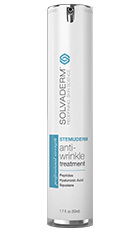
For readers who prefer the peptide route, Stemuderm is the product we feature. The official product page lists Matrixyl 3000, hyaluronic acid (sodium hyaluronate), Argireline, Syn-Ake, Argirelox (acetyl hexapeptide-8 & pentapeptide-18), Snap-8 (acetyl octapeptide-3), squalane, jojoba seed oil & lactic acid. Retinol is not mentioned on the page. Directions are to cleanse, apply after a serum and smooth a small amount over the face, neck & chest twice daily, with sunscreen in the morning.
The page states a 60-day money-back guarantee, and it displays a rating of 4.85 out of 5 from 3,454 reviews. The brand is Solvaderm, owned and operated by All Web Shopping, LLC. A few points keep expectations realistic. Within those limits, a peptide-based cream with a hydrating base is a sensible option for people who want a gentler routine or who cannot use retinol. It is a supportive step for the appearance of lines, & it works best alongside sunscreen.
Where the Product Reviews Fit
Readers often arrive here while comparing specific creams. We have separate reviews for several well-known names, and each can be read through the lens above. The questions to ask about any of them are the same: Which active is named? Is a concentration listed? Is there a published study of the finished product? What are the return terms?
- Koriderm Time Reverse Cream review: read the ingredient panel against the label checklist below.
- Miami MD review: compare the named actives & return terms.
- Noor WonderLift Cream review: check whether the page lists concentrations.
- LifeCell review: look for subscription & guarantee details.
- Particle for Men Face Cream review: note whether the active is a peptide, a retinoid or neither.
Our reviews summarize what each brand publishes and the feedback we found. They are not head-to-head trials, and a review is only a starting point before you read the label yourself.
Label-Reading Checklist
- Find the actives. Look for retinol, retinal, retinyl esters or named peptides such as palmitoyl pentapeptide-4, acetyl hexapeptide-8 or palmitoyl tripeptide-1.
- Check the order. Ingredients are listed from highest to lowest amount, so an active near the end is likely present in small amounts.
- Look for a percentage. Brands that publish concentrations make comparison easier.
- Check packaging. Retinol is sensitive to light & air, so airless pumps & opaque tubes protect it better than open jars.
- Read the claims carefully. “Clinically tested” can mean many things. Ask whether the finished product or only an ingredient was studied.
- Confirm the seller. Make sure the company name on checkout & receipt matches the one offering the guarantee.
- Read the return terms. Note the number of days, whether shipping is refunded & whether a subscription is created.

Common Mistakes That Stall Results
- Switching too soon. Changing products every few weeks resets the clock, because both ingredients work gradually.
- Skipping sunscreen. Ultraviolet exposure keeps creating the damage that the product is trying to soften, so the routine works against itself.
- Applying too much. A pea-sized amount covers the face. Extra product adds irritation risk without adding benefit.
- Layering strong actives. Using retinol, exfoliating acids & scrubs on the same night is a common cause of a damaged skin barrier.
- Judging by one photo. Lighting, expression & hydration change how lines appear from day to day, so compare photos taken in the same light at the same time of day.
- Ignoring the neck & hands. Skin there ages too, and many routines stop at the jawline.
Avoiding these habits matters as much as the ingredient you choose. A modest product used correctly for twelve weeks will usually outperform a stronger one used inconsistently.
Frequently Asked Questions
Q: Which is better for wrinkles, peptides or retinol?
Retinoids have the stronger research base, especially for fine lines. Peptides are gentler, with a smaller & more mixed evidence base. The better choice is the one you can use consistently.
Q: Can peptides replace retinol?
Possibly for some people. In a 2010 trial, a regimen with peptides, niacinamide & a retinol-family ingredient matched prescription tretinoin at 24 weeks. That regimen was not peptide-only, so the result does not prove peptides alone can replace a retinoid.
Q: How long does it take to see results?
Plan on at least 8 to 12 weeks. Early changes are usually in texture & hydration, with fine lines changing more slowly.
Q: Can I use peptides and retinol together?
Many people do. A common approach is peptides in the morning & retinol at night. Introduce them one at a time.
Q: Is retinol safe during pregnancy?
Retinol is generally avoided during pregnancy & nursing. Check with your doctor about any active ingredient.
Q: Do peptides cause irritation?
Studies describe them as well tolerated, but any product can irritate. Patch test first, particularly with formulas that also contain acids.
Q: Do I need a prescription for retinol?
No. Cosmetic retinol is sold over the counter. Tretinoin is prescription only.
Q: Will either ingredient remove deep wrinkles?
No topical product can be counted on to remove deep wrinkles. The research supports modest improvement in the appearance of fine lines.
Q: Are these products approved by the FDA?
The FDA does not approve cosmetics before sale. Prescription tretinoin is a regulated drug. Treat any “FDA approved” wording on a cosmetic page with caution.
Q: Do I still need sunscreen?
Yes. Daily broad-spectrum sunscreen is the most effective everyday step for slowing visible aging, with either ingredient.
The Final Word
When you step back, Peptides vs retinol for wrinkles is not a contest with one clear winner. Retinoids have the stronger evidence, and peptides offer a gentler way to stay consistent. A realistic routine uses sunscreen every day, one active at a time and patience for at least 12 weeks. If you want the peptide route, Stemuderm is the option we feature; if you want the stronger, better-studied path, talk to a dermatologist about retinoids.
Whichever you choose, read the label, patch test, and keep notes & photos so you can judge results honestly. Peptides vs retinol for wrinkles will keep changing as new trials appear, so we update this guide as the research develops.
You May Also Like to Read: Best Professional-Grade Firming Serums Ranked 2026
References
- Sitohang IBS, Makes WI, Sandora N, Suryanegara J. Topical tretinoin for treating photoaging: a systematic review of randomized controlled trials. International Journal of Women’s Dermatology. 2022;8(1):e003.
- Lin L, Chen X, Liu C, et al. Comparative efficacy of topical interventions for facial photoaging: a network meta-analysis. Scientific Reports. 2025;15:26889.
- Spierings NMK. Evidence for the efficacy of over-the-counter vitamin A cosmetic products in the improvement of facial skin aging: a systematic review. Journal of Clinical and Aesthetic Dermatology. 2021;14(9):33-40.
- Robinson LR, Fitzgerald NC, Doughty DG, Dawes NC, Berge CA, Bissett DL. Topical palmitoyl pentapeptide provides improvement in photoaged human facial skin. International Journal of Cosmetic Science. 2005;27(3):155-160.
- Fu JJJ, Hillebrand GG, Raleigh P, et al. A randomized, controlled comparative study of the wrinkle reduction benefits of a cosmetic niacinamide/peptide/retinyl propionate product regimen vs. a prescription 0.02% tretinoin product regimen. British Journal of Dermatology. 2010;162(3):647-654.
- Nukaly HY, et al. Oral and topical peptides for skin aging: systematic review and meta-analysis of randomized controlled trials. Frontiers in Medicine. 2026;13.
- Blanes-Mira C, et al. A synthetic hexapeptide (Argireline) with antiwrinkle activity. International Journal of Cosmetic Science. 2002;24(5):303-310.
- Stemuderm official product page, read November 23, 2026.