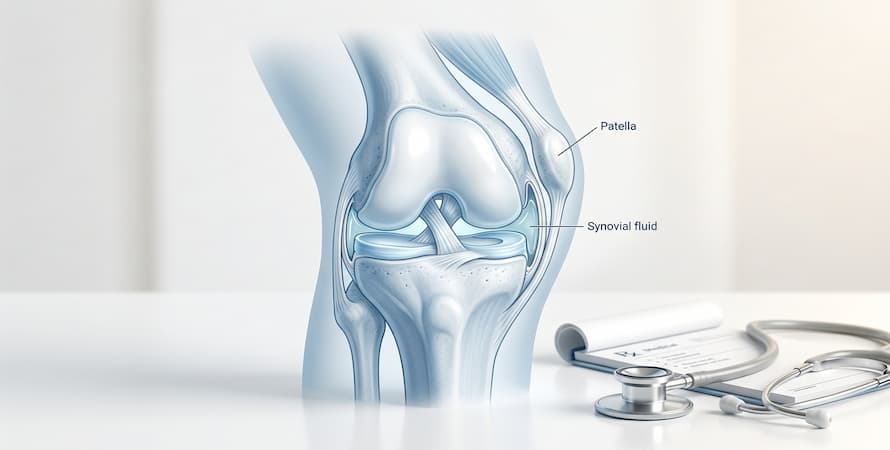

Osteoarthritis is a common joint disorder, affecting millions of Americans. The cases of OA increase as the aging population continues to rise, as well as the prevalence of obesity. Still, many other factors lead to the development of osteoarthritis, which could be the primary reasons or causes of osteoarthritis.
What Is Osteoarthritis?
Although osteoarthritis can damage any joint of your body, it remains a very painful disorder usually affecting the knees, hips, spine, and hands. There are two main types of osteoarthritis, even though there are over 100 different kinds of arthritis!
You need to know which type of arthritis you have – to find the best treatment of osteoarthritis for you – including ways to manage it. Although osteoarthritis symptoms can be lessened, the damage to your joints cannot be reversed.
Some of the things you should do are to keep your weight under control, enjoy an active lifestyle, and take excellent treatment plans that can slow the progression of OA and help to improve your joint function and pain.
Who Gets Osteoarthritis? Risk Factors
There are several reasons for the development of warning signs of osteoarthritis and how people get affected. Let’s see what they are.
- Aging: Aging should always be viewed as one of the warnings signs of osteoarthritis because many diseases plus OA chances increase as you age.
- Gender: It seems women are more likely to develop osteoarthritis, although the reasons are not clear.
- Obesity: Put it simply like this. The more you weigh, the greater your risk for osteoarthritis, particularly your weight-bearing joints, like your knees and hips. Fat tissues produce proteins and these can cause nasty inflammation in and around your joints, which are typical warning signs of osteoarthritis.
- Joint injuries: When you encounter injuries like those from sports or accidents, you increase the risk of developing symptoms of osteoarthritis. Even those injuries that occurred years back, which you thought had healed can cause osteoarthritis, particularly if you place repeated stress on those joints.
- Genetics: It is possible to inherit a tendency to develop osteoarthritis.
Bone deformities: Some people are born with defective cartilage or malformed joints – doctors may tell you about the warning signs of osteoarthritis as a result.
- Metabolic diseases: These can be diseases like diabetes, which could lead to a condition called hemochromatosis, which is also one of the causes of osteoarthritis.
The Types of Osteoarthritis
The two main types of osteoarthritis are:
Primary Osteoarthritis & Secondary Osteoarthritis
1. Primary osteoarthritis happens when the cartilage, which is the rubbery material that allows friction of your joints to be easy, breaks down.
It usually affects fingers, thumbs, spine, knees, hips, and big toes. When you use your joints over and over, particularly in older people, the cartilage gets damaged and becomes painful and swollen.
If you have a severe case of osteoarthritis, you can even lose all the cartilage that is between the bones of the joints, so that they rub together, making it much more painful. You should look out for these painful warning signs of osteoarthritis!
2. Secondary osteoarthritis happens when the cartilage becomes damaged from diseases like diabetes, or medical conditions. These can be obesity, for instance, injuries to your joints, unnatural joints at birth, and things that change the way your body works.
An example could be an unusual way of walking that puts more stress on your bones. Other warning signs of osteoarthritis can be the start of gout, hormonal disorders, and even menopause, which affect the levels of estrogen in your body, and can cause secondary osteoarthritis.

Other Types of Osteoarthritis and The Causes of Osteoarthritis in These Areas
1. Hip osteoarthritis.
Hip osteoarthritis is frequently missed early, because people do not expect hip problems to be felt in the groin.
How it presents
- Groin pain — the most characteristic symptom, and the one most often misattributed. Pain over the outer hip is more often bursitis or tendon-related than hip osteoarthritis.
- Pain referred to the front of the thigh and the knee — some people present with knee pain and turn out to have a hip problem
- Buttock pain in some cases
- Stiffness, particularly first thing in the morning and after sitting
- Difficulty putting on socks and shoes, or cutting toenails, because these require the hip to bend and rotate together
- A limp, and reduced walking distance
- Difficulty getting in and out of a car
- Night pain in more advanced disease
- Loss of rotation — restricted internal rotation is often the earliest examination finding
Risk factors specific to the hip
- Femoroacetabular impingement (FAI) — a shape variation where the ball and socket make abnormal contact, now recognized as a significant contributor
- Hip dysplasia — a shallow socket, sometimes undetected since childhood
- Previous hip fracture or dislocation
- Avascular necrosis of the femoral head
- Childhood hip conditions such as Perthes disease or slipped upper femoral epiphysis
- Heavy physical occupations, particularly farming, which shows consistently raised rates
- Leg length difference
Treatment notes
- Exercise therapy focusing on the gluteal and hip muscles, with good evidence for pain and function
- Weight management, since the hip is also weight-bearing
- A walking stick in the opposite hand, which meaningfully reduces load through the hip
- Topical NSAIDs are less useful here than at the knee, because the hip lies deep beneath muscle, so oral medication is more commonly used
- Corticosteroid injection, usually performed under imaging guidance given the joint’s depth
- Total hip replacement, which is among the most successful operations in orthopedics for pain relief and restored function
2. Foot and ankle osteoarthritis.
How it presents:
- Big toe joint (hallux rigidus) — the most commonly affected site in the foot. Pain and stiffness at the base of the big toe, worse on pushing off when walking, with a bony bump developing on top of the joint and difficulty wearing certain shoes.
- Midfoot — aching across the arch, worse with prolonged standing and walking, sometimes with a bony prominence on top of the foot.
- Ankle — less commonly affected by primary osteoarthritis than the knee or hip. Most ankle osteoarthritis is post-traumatic, following a previous fracture or repeated sprains, which is the main way it differs from other sites.
Risk factors: previous fracture, recurrent ankle sprains, flat or high-arched foot shape, inflammatory arthritis, and occupations involving prolonged standing.
Treatment notes: supportive footwear with a stiff sole, orthotics, a rocker-bottom shoe for big toe osteoarthritis, activity modification, NSAIDs, injection, and surgery including fusion or ankle replacement in selected cases.
3. Knee Osteoarthritis
The knee is the most commonly affected joint, and knee osteoarthritis accounts for a large share of the overall burden of the disease.
How it presents
- Pain that worsens with activity and eases with rest — particularly stairs, especially going down, squatting, kneeling, and getting up from a low chair
- Short-lived morning stiffness, typically resolving within 30 minutes
- Gelling — stiffness after sitting still for a while, which wears off within a few minutes of moving
- Crepitus — a grating, crunching, or crackling sensation felt or heard on movement
- Swelling, which may come and go, and can flare after unaccustomed activity
- A sense of giving way or instability, usually from muscle weakness rather than ligament damage
- Bow-legged or knock-kneed appearance developing gradually in advanced cases, as one side of the joint wears more than the other
- Difficulty fully straightening the knee as the condition progresses
Knee osteoarthritis most often affects the inner (medial) compartment first, which is why a gradually bow-legged appearance is the common pattern.
Risk factors specific to the knee
- Excess body weight — the strongest modifiable risk factor for the knee specifically, since load through the joint is a multiple of body weight with each step
- Previous knee injury — particularly anterior cruciate ligament tears and meniscal tears, which substantially raise the risk of osteoarthritis developing years later
- Previous meniscal surgery, especially removal of meniscal tissue
- Occupational kneeling, squatting, and heavy lifting
- Quadriceps weakness
- Joint malalignment
- Female sex, particularly after menopause
Treatment notes
Exercise and weight management do more for knee osteoarthritis than anything else available, and both have stronger evidence than most people expect.
- Quadriceps strengthening is the single most useful exercise intervention. Weak thigh muscles leave the joint less supported, and strengthening reliably reduces pain and improves function.
- Weight reduction produces measurable symptom improvement, with benefit increasing as more weight is lost.
- Topical NSAID gel is often recommended before oral medication for the knee, since the joint is relatively superficial and topical treatment avoids much of the systemic risk.
- A walking stick, used in the hand opposite the affected knee, reduces load through the joint.
- Corticosteroid injection helps short-term during a flare.
- Total knee replacement is considered for severe symptoms and significant functional limitation once other measures are exhausted, and generally has good outcomes.
- Arthroscopic surgery is not recommended for osteoarthritis alone, as the evidence does not support benefit.

4. Hand osteoarthritis.
Hand osteoarthritis has the strongest hereditary pattern of the common types, and a distinctive appearance that often makes it recognizable at a glance.
How it presents
Three sites are typically involved:
- The joints closest to the fingertips (DIP joints) — where firm bony swellings called Heberden’s nodes develop
- The middle finger joints (PIP joints) — where similar swellings are called Bouchard’s nodes
- The base of the thumb (first carpometacarpal joint) — often the most functionally limiting site
Symptoms include:
- Aching and stiffness in the fingers, worse in the morning but short-lived
- Firm, bony enlargement of the affected joints, which is permanent once formed
- Pain with pinching and gripping — opening jars, turning keys, using a can opener, pinching a pen
- Reduced grip strength
- Loss of dexterity with small tasks such as buttons and zips
- Sideways deviation of the affected finger joints over time
- A squaring appearance at the base of the thumb in thumb base osteoarthritis
An important distinction: the bony swellings of hand osteoarthritis are hard and develop slowly. Soft, warm, boggy swelling of the knuckles, particularly on both hands symmetrically with prolonged morning stiffness, points toward rheumatoid arthritis instead and needs different assessment.
Risk factors specific to the hand
- Family history — hand osteoarthritis, particularly the nodal pattern, runs strongly in families
- Female sex, with onset often clustering around and after menopause
- Previous hand or wrist injury
- Occupations involving repetitive gripping or pinching
Treatment notes
- Hand therapy, delivered by a hand therapist or occupational therapist, covering joint protection techniques and strengthening
- A thumb base splint for first carpometacarpal osteoarthritis, which can substantially improve pinch-related pain
- Adaptive equipment — jar openers, wide-grip utensils, lever taps, book holders
- Topical NSAIDs, well suited here given how superficial the joints are
- Corticosteroid injection, particularly into the thumb base
- Surgery for the thumb base, including trapeziectomy or fusion, where symptoms are severe and conservative measures have failed
- Finger joint replacement or fusion, used selectively
There is also an uncommon subtype, erosive osteoarthritis, which is more inflammatory in character, more painful, and causes more joint destruction than typical hand osteoarthritis. It is worth knowing it exists, since it can be mistaken for inflammatory arthritis.
5. Spinal osteoarthritis.
Osteoarthritis in the spine affects the small facet joints that link the vertebrae, and it usually occurs alongside degenerative changes in the discs. It is most common in the neck and the lower back, the two most mobile regions.
Cervical (neck) osteoarthritis
How it presents:
- Neck pain and stiffness, often worse in the morning and after sustained postures
- Reduced ability to turn the head, noticed when reversing a car or checking a blind spot
- Grinding or crunching sensations on neck movement
- Headaches originating at the base of the skull
- Pain referred into the shoulder blade or upper arm
- Where a nerve root is compressed, pain, tingling, numbness, or weakness travelling down one arm
Worth knowing: degenerative changes on neck imaging are extremely common with age and are frequently present in people with no symptoms at all. Their presence on a scan does not by itself explain neck pain.
Lumbar (lower back) osteoarthritis
How it presents:
- Lower back pain and stiffness, often worse in the morning and easing with gentle movement
- Pain worse with standing, walking, and leaning backward, and relieved by sitting or leaning forward — this pattern is characteristic and distinguishes facet-related pain from disc-related pain, which typically worsens with sitting and bending forward
- Pain referred into the buttocks and the back of the thighs
- Stiffness after prolonged sitting
Spinal stenosis can develop when bone spurs and thickened tissue narrow the space around the spinal cord and nerves. Its hallmark is neurogenic claudication: leg pain, heaviness, or numbness that comes on with walking or standing and is relieved by sitting or bending forward. People often notice they can walk further when leaning on a shopping trolley.
Risk factors specific to the spine
- Age, with degenerative changes becoming near-universal over time
- Previous spinal injury
- Occupations involving heavy lifting, prolonged driving, or vibration exposure
- Excess body weight
- Scoliosis or other structural variation
Treatment notes
- Exercise and core strengthening, which has the best evidence for spinal symptoms
- Physical therapy, including posture and movement retraining
- Heat for stiffness
- NSAIDs for symptom control
- Facet joint injections or epidural injections, used selectively
- Decompression surgery for spinal stenosis with significant walking limitation
Seek urgent medical attention for new weakness in the legs, numbness around the groin or inner thighs, or loss of bladder or bowel control. These are red flag symptoms requiring immediate assessment.
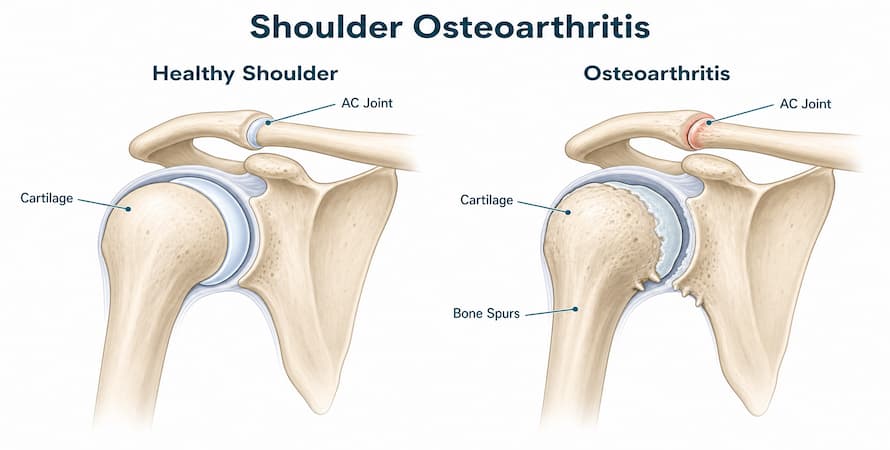
6. Shoulder osteoarthritis.
The shoulder involves two separate joints that can each develop osteoarthritis, and they present quite differently. The existing article treats the shoulder as one entity, which obscures a useful distinction.
Glenohumeral osteoarthritis (the main ball-and-socket joint)
How it presents:
- Deep, aching pain felt within the shoulder itself
- Pain worse with movement, particularly reaching overhead or out to the side
- Marked loss of external rotation — difficulty rotating the arm outward is often the earliest and most telling sign
- Grinding or catching sensations
- Night pain, particularly when lying on the affected side, which is often what drives people to seek help
- Difficulty reaching behind the back, for fastening a bra or retrieving a wallet
Acromioclavicular (AC) joint osteoarthritis
How it presents:
- Pain localized to the top of the shoulder, which people can often point to with one finger
- Pain on reaching across the body
- Pain when lying on that shoulder
- A visible or palpable bump over the top of the shoulder
- Often coexists with rotator cuff problems
Risk factors specific to the shoulder
- Previous shoulder dislocation, particularly recurrent dislocation
- Previous fracture of the upper arm or shoulder blade
- Rotator cuff tear arthropathy — long-standing large rotator cuff tears alter shoulder mechanics and lead to a distinct pattern of joint damage
- Overhead occupations — painting, construction, electrical work
- Overhead and throwing sports
- Weightlifting, particularly heavy bench pressing, which loads the AC joint
Treatment notes
- Exercise therapy targeting the rotator cuff and the muscles controlling the shoulder blade
- Activity modification, reducing overhead loading
- NSAIDs, topical or oral
- Corticosteroid injection, often image-guided
- Shoulder replacement for advanced glenohumeral osteoarthritis. Where the rotator cuff is intact, a standard replacement is used; where it is deficient, a reverse shoulder replacement is designed to work without a functioning cuff
- Distal clavicle excision for isolated AC joint osteoarthritis that does not settle
What Are the Causes of Osteoarthritis?
Osteoarthritis occurs when the cartilage that gives you frictionless joint motion deteriorates. The cartilage eventually wears down until bones rub against bones. Osteoarthritis affects the entire joint and causes the bones to change and deteriorate.
Inflammation sets in in the joint lining – that’s exactly what osteoarthritis is – joint inflammation. It is caused by aging, injury from disease and trauma, and can even be hereditary.
Comparing the Types at a Glance
| Type | Where pain is felt | Most telling early sign | Key risk factor beyond age |
|---|---|---|---|
| Knee | Around and below the kneecap, inner side | Pain on stairs and getting up from a chair | Excess weight; previous ACL or meniscal injury |
| Hip | Groin, front of thigh, sometimes knee | Difficulty putting on socks and shoes | Hip shape variations (FAI, dysplasia) |
| Hand | Fingertip and middle finger joints; thumb base | Bony knobbly swellings; trouble opening jars | Family history; female sex |
| Spine — neck | Neck, base of skull, shoulder blade | Reduced head turning | Occupational loading; previous injury |
| Spine — lower back | Lower back, buttocks, thighs | Pain worse standing, better sitting | Heavy lifting; excess weight |
| Shoulder | Deep in shoulder, or on top for AC joint | Loss of outward rotation; night pain | Previous dislocation or fracture; overhead work |
| Foot and ankle | Big toe base, midfoot arch, ankle | Pain pushing off when walking | Previous fracture or repeated sprains |
The pattern worth noticing: in weight-bearing joints such as the knee, hip, and spine, body weight and load are dominant factors, and weight management is a core part of treatment. In the hand and shoulder, heredity and previous injury matter more, and treatment focuses on joint protection, strengthening, and adapting how tasks are performed.
How Osteoarthritis Is Diagnosed
Diagnosis is usually clinical
Osteoarthritis can often be diagnosed from the history and examination alone, without any test. Widely used clinical criteria support a confident diagnosis in someone who is 45 or older, has joint pain related to activity, and has either no morning stiffness or morning stiffness lasting no more than about 30 minutes.
A doctor will ask which joints are affected, whether pain worsens with use and eases with rest, how long morning stiffness lasts, about previous injuries and occupation, and about family history. The examination checks range of motion, crepitus, bony enlargement, swelling, tenderness, alignment, muscle bulk, and how the joint functions in practice.
X-rays
X-rays show four characteristic changes:
- Joint space narrowing, reflecting cartilage loss
- Osteophytes — bone spurs at the joint margins
- Subchondral sclerosis — increased bone density beneath the cartilage
- Subchondral cysts
The most important thing to understand about osteoarthritis imaging is that X-ray findings correlate poorly with symptoms. Many people with significant changes on X-ray have few or no symptoms, and many people with substantial pain have relatively mild-looking X-rays. Treatment is guided by symptoms and function, not by how the scan looks. This is worth emphasizing, because people often assume an X-ray result determines how bad their condition is.
MRI
MRI shows cartilage, ligaments, menisci, and bone marrow changes in detail. It is not routinely needed to diagnose osteoarthritis and is reserved for unclear cases, suspected additional injury, or surgical planning.
Blood tests
There is no blood test for osteoarthritis. Blood tests are used to exclude other conditions — inflammatory markers, rheumatoid factor and anti-CCP antibodies, and uric acid where gout is a consideration. In osteoarthritis these are typically normal, and normal results support rather than undermine the diagnosis.
Conditions that can look similar
Rheumatoid arthritis, psoriatic arthritis, gout, bursitis, tendon problems, referred pain from another joint, and in the hip and shoulder, referred pain from the spine.

What Symptoms Show Up in Osteoarthritis?
Signs and symptoms of osteoarthritis will show up as pain in the affected joints from repetitive use. Osteoarthritis can affect many different joints, so this pain can be expected in the hands, hips, knees, lower back, and neck pain.
Other signs and symptoms of osteoarthritis that you will notice will be swelling of the joints, stiffness, creaking and cracking joints, and even loss of range of motion. You could also develop joint deformity, but this is usually in the more severe cases.
Treatment That Applies Across All Types
Although each joint has its own specifics, the foundations of osteoarthritis treatment are the same everywhere. Guidelines consistently place the same three things first, regardless of which joint is affected.
The core three
1. Exercise. The strongest evidence of any osteoarthritis treatment, for every affected joint. It reduces pain, improves function, and strengthens the muscles supporting the joint. The common fear that exercise wears joints out faster is not supported by the evidence — appropriate exercise protects joints. A mix of strengthening, range of motion work, and low-impact aerobic activity works best, started gently and built up gradually.
2. Weight management. Relevant particularly for the knee, hip, spine, and foot, where load is multiplied through the joint with each step. Even modest weight loss produces measurable symptom improvement.
3. Education and self-management. Understanding that osteoarthritis is manageable, that activity is safe, and how to pace activity through flares changes outcomes substantially.
Adding to the core
- Physical and occupational therapy for individualized programs, joint protection techniques, and adaptations
- Topical NSAIDs for superficial joints — knee, hand, foot
- Oral NSAIDs at the lowest effective dose for the shortest period, with attention to stomach, kidney, and cardiovascular risk
- Acetaminophen, with more modest evidence than was once assumed
- Duloxetine, used for persistent osteoarthritis pain in some cases
- Corticosteroid injection for flares, with a limit on how often it is repeated into the same joint
- Supportive devices — walking sticks, braces, splints, orthotics, supportive footwear
- Heat and cold, heat for stiffness and cold for an acutely swollen joint
- Sleep and mood support, since poor sleep and low mood both amplify pain
- Joint replacement surgery where symptoms are severe, function is significantly limited, and other measures have been exhausted
Supplement support across osteoarthritis types
Supplements are among the most searched-for options in osteoarthritis, so it is worth being clear about what they can and cannot do.
No supplement has been shown to repair or regenerate cartilage, and none modifies the underlying course of osteoarthritis. Cartilage loss is not reversed by anything currently available, in supplement or prescription form. Any product claiming to rebuild cartilage is overstating what is known. Supplements also do not replace the core three above, which is where the actual evidence sits.
Within those limits, some people use supplements as part of a broader routine for joint comfort and mobility. Combination formulas such as Flexoplex Joint Support bring together ingredients commonly used to support joint comfort, flexibility, and everyday mobility across the joints affected by osteoarthritis, which may make it easier to keep up the exercise and daily activity that treatment depends on.
A few practical points if you are considering any supplement:
- Speak with your doctor or pharmacist first, particularly if you take blood thinners, diabetes medication, or other prescription treatments, as interactions are possible
- Give it a fair trial period and assess honestly whether it is helping, rather than continuing indefinitely out of habit
- Do not delay assessment of a painful joint in order to try a supplement first. Joint pain that is new, severe, accompanied by swelling and redness, or associated with fever needs a diagnosis, since not all joint pain is osteoarthritis
- Treat supplements as an addition to exercise and weight management, not a replacement for them.
Frequently Asked Questions
Q: Can osteoarthritis be reversed?
No. Cartilage loss cannot currently be reversed by any available treatment. However, symptoms can be substantially reduced and function preserved for many years, and many people manage osteoarthritis well over decades. The absence of a cure is not the same as the absence of effective treatment.
Q: Does osteoarthritis spread from one joint to another?
Osteoarthritis is not contagious between joints and does not spread in the way an infection does. What can happen is that pain in one joint changes how a person moves, placing more load on other joints, which over time may contribute to problems elsewhere. That is a reason to address gait and movement, not evidence of spread.
Q: Will exercise wear my joints out faster?
No. This is one of the most common concerns and the evidence points firmly the other way. Appropriate exercise reduces pain and improves function, and strong muscles protect joints. What causes problems is sudden large increases in activity, not regular graded exercise.
Q: Does cracking joints cause osteoarthritis?
No. Studies have not found a link between knuckle cracking and developing osteoarthritis.
Q: Is osteoarthritis the same as “wear and tear”?
Not quite, and the phrase is somewhat misleading. Osteoarthritis involves active biological changes in cartilage, bone, and the joint lining, not simple mechanical erosion like a worn tire. The distinction matters, because “wear and tear” implies that using the joint less will help, when in fact appropriate use helps and inactivity harms.
Q: At what age does osteoarthritis start?
It becomes more common from middle age onward, but it is not exclusively a condition of older age. Osteoarthritis following a joint injury can appear decades earlier — someone with an ACL tear in their twenties may develop knee osteoarthritis in their thirties or forties.
Q: Does weather affect osteoarthritis?
Many people report that symptoms feel worse in cold, damp weather or when pressure changes. Research findings are mixed on whether weather genuinely affects the condition, but the experience is common enough that planning around it is reasonable.
Q: Should I avoid certain foods?
No specific food causes or worsens osteoarthritis, and the commonly repeated advice to avoid tomatoes and other nightshades is not supported by evidence. A generally balanced diet supports weight management, which does matter.
Q: How do I know if it’s osteoarthritis or rheumatoid arthritis?
The main clues are stiffness duration and pattern. Osteoarthritis causes morning stiffness lasting under 30 minutes and often affects joints asymmetrically. Rheumatoid arthritis causes stiffness lasting more than an hour, typically affects small joints on both sides of the body symmetrically, produces soft warm swelling rather than hard bony enlargement, and comes with fatigue and other whole-body symptoms. Rheumatoid arthritis needs prompt specialist treatment, so this distinction is worth getting checked rather than assuming.
Q: When should I consider joint replacement?
Generally when pain is persistent and significantly limiting daily life, when it disturbs sleep regularly, and when exercise, weight management, medication, and injections have been tried without adequate benefit. It is a decision made with a surgeon based on symptoms and function rather than on X-ray appearance alone.
Conclusion
Osteoarthritis is a painful, degenerative condition. Nobody wants it, because it can ‘cripple’ your life if left untreated. Over time, it just gets worse. Death is not usually a result of the causes of osteoarthritis; it’s rare. But it can be debilitating to the point that you need to speak to your doctor if it is impacting your quality of life.
Many older people and some young ones with osteoarthritis want to know if there is anything they can do to stop it. In some instances, even the pain from this disease can cause people to walk, stand, or move differently.
This, in turn, can force other joints to go out of alignment and cause the osteoarthritis to spread there too. The best advice is to maintain an ideal weight to avoid overusing the joints and follow an exercise plan to strengthen the muscles and support the joints. Your doctor or therapist can help you with these.
Fortunately, there is hope to reduce the causes of osteoarthritis, and to increase your mobility to enhance the quality of life.
References
https://www.niddk.nih.gov/health-information/liver-disease/hemochromatosis/clinical-trials
https://pmc.ncbi.nlm.nih.gov/articles/PMC2735835/
https://pmc.ncbi.nlm.nih.gov/articles/PMC1948850/
https://pmc.ncbi.nlm.nih.gov/articles/PMC3867970/
https://pmc.ncbi.nlm.nih.gov/articles/PMC10965372/